

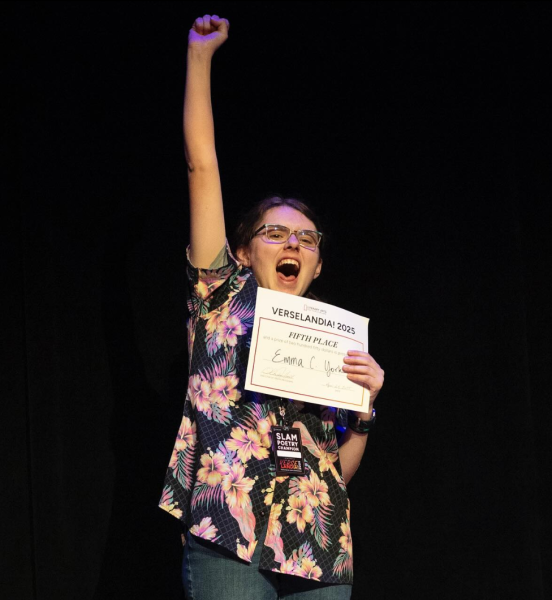
Emma York is becoming a Verselandia! regular.
A Franklin junior, she competed for a second time at the citywide youth poetry slam at the Arlene Schnitzer Concert Hall on April 30. The event features the best high school poets from around the city.
Each competitor had to qualify by placing first or second in their school’s own poetry slams. At Franklin, York made it past a talented poet pool to clinch first place and take the stage at Verselandia!.
Franklin Poetry Slam
York’s poetry season began in the Franklin library on the evening of April 15. Despite her convincing performance at Verselandia! last year, York found herself in a close battle with the 18 other competitors vying for the two qualifying spots.
Poetry slams are two-round competitions — round one includes all the competitors, and round two features the highest scoring competitors from the previous round to perform a new poem. The highest scorer from round two wins the slam, even if they didn’t win round one.
York delivered a smooth performance in round one. She debuted a poem themed around the principle of conservation of information. A fundamental law of physics, it states that anything can be reconstructed because the energy and matter cannot be destroyed.
For the purposes of her poem, York uses the scientific to prove the literary: how the past can not only repeat itself, but be reconstructed and traced.
“Do you remember your first kiss? It doesn’t matter; somewhere behind us remains / All of the infinite moments you spent in that kiss, accessible and viewable; when you / Die and rot back into the soil they can pull up a core sample of that dirt and / Reconstruct what you thought about while it was happening”
Stylistically, York says she loves to have a very concrete basis for her poems. “I try to be analytical and objective and give people a bird’s eye view of what’s going on,” she explains, adding, “I feel like it’s the best way to convey an emotion.”
“All of this to say, you — what makes you you, all of those emotions and memories and / traits — remain in the world like a stubborn fingerprint on glass, like a thick file / In an unfathomably large archive, so large we can only understand fragments of it.”
She wrapped up her poem to thunderous applause from the parents, teachers, and students in the audience, finishing with a deep exhale and a grin.
York’s average score of 9.05 was enough to put her comfortably into the second round.
The two-round format of the slam can make picking which poem goes first and which one goes second a difficult choice. Pick your best poem first and you can hurt your chances in round two. Save your best poem for last and risk not qualifying.
“Usually the better one goes first,” says York, opting to play it safe. “I like the one I did [first] this time, because I felt like it was a really solid slam poem. The second one is weird and wacky.”
The slam resumed for round two after a 15 minute intermission, where York got to present her second and “more important” poem. She painted an apocalyptic picture, about humans on the brink of extinction and the last of our species holding on. “It’s about how, if the world ends, we have coping strategies,” says York. “We’ll survive as a species. It might be painful, but we’ll do it.”
“Change your mind for one night. For one night. / Just make it one more night. One foot in front of the other, love. / Anything that makes this bearable is worth it.”
She also says that this poem is incredibly personal, noting that the apocalyptic scenery is really an allusion to a more individual issue. “It’s not me telling you about the apocalypse,” says York. “It’s me telling myself not to die.” She says the poem hits on a personal motif of persistence. “We gotta keep going,” she says, forcing a grim smile.
“For me. For the Sunset. For the Sunrise. / Get back up, my love. / One more day. And then another. And then another. / After enough days, we will see peace again.”
Impressed, the judges gave York winning scores of 8.9, 9.0, 9.7, and 9.8, just barely edging her out past sophomore Soraya Garcia Worthy, who placed third at the Franklin slam last year.
“I feel pretty good about it,” York said through a grin after receiving her award, noting that the real work had yet to begin. “I’m definitely going to be practicing more.”
Franklin Librarian Ellen Pederson hosted the Franklin slam for her first time this year and was well impressed by the high level of poetry. “The thoughtfulness, the quality, the depth!,” she raved, after the awards had wrapped up. “Their poems are powerful. They have such strong writing and such strong speaking.”
Verselandia! 2026
With just two weeks before Verselandia!, York went back to the drawing board for both of her poems, making sure that they were slam ready.
“I don’t write my poetry in this purely self-expression way,” she says. “There are things that I would want to write that I would never slam because it’s not going to do well.” York is careful to keep the audience and judges in mind when writing and refining her slam poems specifically. She says a good slam poem always keeps the audience in mind and the judges engaged.
Keeping her poems away from the typical slam topics is an important strategy toward her success. “People talk about the same, you know, sexism, racism, transphobia, homophobia, which are all amazing slam topics,” she says. “But from a purely competitive standpoint, you doing those is either really really good or really really bad. You have to be the best person who does that one topic, or get overshadowed by the rest,” explains York. With twenty other poets, standing out in front of the judges is important. “If you do a weird, crazy topic, you can’t get overshadowed.”
Off the back of a strong fifth-place finish the year prior, York was ready to make a splash at this year’s competition. Spectators filled the Arlene Schnitzer Concert hall for the 7 p.m. show, and 21 high school poets from around Portland took their seats in the front of the orchestra pit to compete for the $1000 first prize.
This year, however, the odds were stacked against her. York had the unlucky pleasure of performing first, while the judges were still figuring out their scoring. Although a “calibration poet” went before the competitive slam began to get the judges ready, going first can be a challenge for both the poet and the judges, who may still be finding their footing.
On stage, she delivered a flawlessly memorized performance of her first poem, earning her an 8.4, 8.8, 9.0, 8.5, and 9.2. After the best and lowest scores were excluded from her average, she earned a 8.77, which 20 poets later, was not enough to get her into the second round.
“I’m happy with it,” she said curtly over text after her performance.
Despite the tough break in this year’s slam, York still has another year to compete. “I never get tired of poetry,” she says. “It just encapsulates the range of human experience, to the point where if I was to say ‘I don’t like poetry,’ I’m really saying ‘I don’t like living.’”