


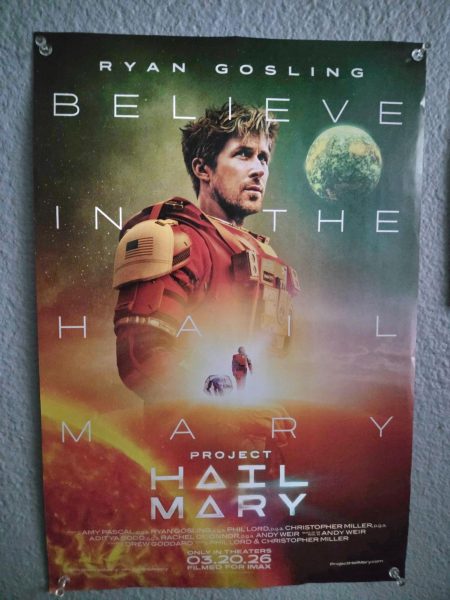
Warning: This article contains spoilers for the book and movie “Project Hail Mary.”
In the 2026 film, “Project Hail Mary,” a man wakes up in a spacecraft nearly 12 light-years from Earth and can’t even remember his own name. Through flashbacks to his past as a microbiologist and middle school teacher on Earth, Dr. Ryland Grace — played by Ryan Gosling — discovers that the sun is dying and the fate of humanity rests in his hands. The fast-paced story unfolds across two distinct timelines: one where Grace is stranded in the Tau Ceti star system and meets an unlikely friend on his quest to save his species, and another in which viewers learn more about Grace’s past and the project that sent him here. This compelling format leaves viewers discovering the conflicts and plot along with the main characters.
“Project Hail Mary” is based on the 2021 novel of the same title. Written by Andy Weir, author of the hit sci-fi novel “The Martian” — which has its own 2015 film adaptation — “Project Hail Mary” (2021) employs the same fragmented timeline as the new movie. “It is a really well done book that is science fiction that works for people who don’t usually enjoy science fiction,” describes Franklin parent Erin Cooley, who read the book last fall. Franklin sophomore Ione Jones similarly has much praise for the book. “It’s one of the only books that I would say is a five-star book. I don’t know if I could say that there’s anything wrong with it,” Jones says.
In the novel, the main characters are portrayed with knowledgeable backgrounds and scientific expertise, which makes the complex science sections much more manageable. “The mood of the book is varied and includes a slow reveal of the story along with geeky discovery and urgent ‘save the world’ energy,” Cooley explains. The 2026 film successfully captures both the gradual discovery and the gravity of the novel.
Although “Project Hail Mary” can sound far removed from modern society because of its faraway setting and the presence of alien life, it has prominent themes of friendship, connection, and sincerity. “Despite the [important] secondary character being inhuman, I really liked how human the movie felt,” says Franklin junior Cor Dudley Borte. Not only does the space timeline feature Grace befriending an alien to save both species, but the Earth timeline centers on international collaboration. A review on scriptmag.com highlights the film’s emotional depth — “This movie has so much heart, and it never lets you forget that beneath all the science and spectacle is a story about connection, vulnerability, and the quiet bravery found in ordinary people.”
“Project Hail Mary” is certainly visually appealing, with colorful cinematography living up to its reported budget of nearly $250 million. Director Christopher Miller told comicbook.com that the entire movie was filmed without green screens, placing large emphasis on the impressive set, which included the interior of an entire spaceship. The film’s cinematographer, Greig Fraser, won an Academy Award for the cinematography of “Dune” and worked hard to ensure “Project Hail Mary” lived up to expectations. The film features awe-inspiring shots, including a spacewalk in front of an alien planet and a virtual simulation of an ocean, which viewers like Jones have praised for adding depth and perspective.
Though many critics have praised Ryan Gosling’s performance, some viewers felt that his casting made the story somewhat problematic. “I was a bit suspicious about … the idea of [a] conventionally-attractive white man who is going to save all of humanity,” explains Dudley Borte. He conveys that he enjoyed the film’s entertaining plot, but wishes that it had placed more emphasis on humanity and collaboration instead of portraying a straight white man as the savior of humanity.
Additionally, the film did not include several important subplots from the novel. “Project Hail Mary” (2021) offered readers a much clearer understanding of how the disaster impacted the planet and its people. It featured multiple scenes of Grace teaching students on Earth — which becomes one of his motivations behind the mission — whereas the film only has one. Jones was somewhat disappointed by these omissions, but still felt that the adaptation captured the plot well and has no major complaints. “It was a really beautiful movie [that] brought me to tears multiple times,” she says.
“Project Hail Mary” is an emotionally meaningful and visually impressive movie that has received extremely high reviews from critics, some of whom described it as “an awe-inspiring and sublimely beautiful masterpiece” and “[having] some of the most stunning outer space sequences ever.” Whether you are looking for a fresh take on first-contact with aliens, a heartfelt tale of international collaboration for the greater good, or beautiful cinematography and A-list actors, “Project Hail Mary” will deliver.