

On the first day of his second term in office, President Donald Trump signed executive order 14160, which aimed to redefine the scope of birthright citizenship. The order was consistent with the rhetoric that animated his first term, where he repeatedly expressed similar intent to end automatic citizenship for children born in the U.S. to non-citizens and undocumented immigrants. Within hours of inauguration, this campaign language solidified into executive policy.
Response to the order was immediate. The Legal Defense Fund, American Civil Liberties Union, and a coalition of other advocacy organizations quickly filed suit. Federal judges in multiple district courts issued preliminary injunctions blocking the order’s enforcement, finding that it likely violated both constitutional text and long-standing judicial precedent. The Supreme Court agreed to take the case, and is in the midst of determining whether Trump’s executive order is unconstitutional, with their decision expected in June of 2026.
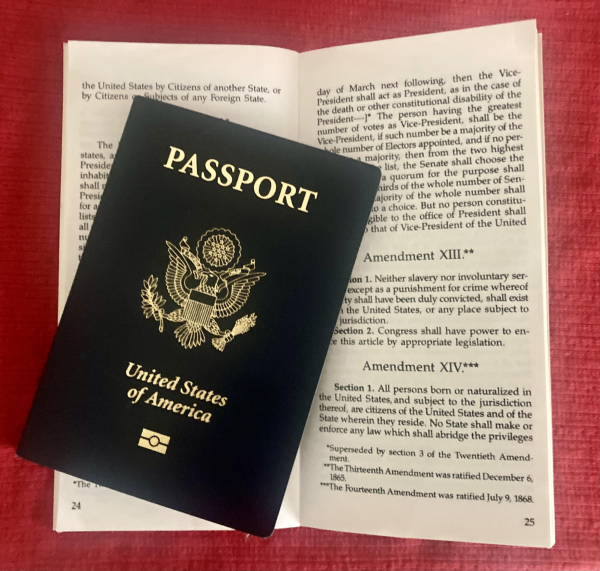
The legal dispute revolves around various interpretations of the 14th Amendment, specifically the provision known as the citizenship clause, which states: “All persons born or naturalized in the United States, and subject to the jurisdiction thereof, are citizens of the United States and of the State wherein they reside.” For decades, that language has been understood to confer citizenship on nearly anyone born on U.S. soil, regardless of the legal status of their parents. The narrow exceptions provided are children of invading forces and of diplomats.
Ratified in 1868 after the Civil War, the 14th Amendment emerged directly from the wreckage of slavery, seeking to overturn the logic of Supreme Court case Dred Scott v. Sandford. That decision deemed that Black people whose ancestors were enslaved were not considered citizens and had none of the consequent protections. To repudiate this, the Amendment created a new provision that upheld equal citizenship, a core principle of the Reconstruction. Birth on American soil — “jus soli” — independent of bloodline, would now be enough to confer citizenship. Today, the majority of Americans hold citizenship through this provision. “There’s something to be said about national unity in a nation that was formed with the participation of people all over the world,” says Rodrigo Juarez Jr., an immigration attorney based in Texas. “It’s a defining characteristic of this country. I think the 14th Amendment is a legacy of that.”
Citizenship remains one of the most powerful forms of inheritance in public life. It can determine where a person may legally vote, work, travel, remain, and return. It shapes access to political participation and levels of protection. Yet, for all the gravity attached to citizenship, many simply acquire it through the happenstance of geography.
To those who possess it securely, citizenship can feel almost invisible. People may not consider it at all, until they face someone striving for it. However, for those navigating naturalization, the process carries enormous emotional and procedural gravity. Applicants memorize legislative structure and presidential histories, and listen as judges describe citizenship as both privilege and responsibility. In the U.S., one can become a citizen after years of intentional effort and legal residence, or by taking a first breath on U.S. soil. The law has long treated those forms of citizenship as fundamentally equal once granted.
In that way, birthright citizenship represents constitutional continuity — the fulfillment of a national commitment that citizenship would not depend on ancestry or race. “Citizenship does an incredible job of equalizing and integrating immigrants,” says Juliet Stumpf, Edmund O. Belsheim professor of law at Lewis & Clark College, and a scholar of immigration and crimmigration law. “It means that we don’t have a lot of the problems that other nations do have, of this sort of second class, this cast of people who don’t have the same rights.”
There is a risk that altering this simplicity will allow citizenship to transform into something more contingent and exclusionary, vulnerable to political swings and administrative discretion. The clarity of the citizenship clause mitigates that instability by treating the event of birth as legally sufficient. There are no demands for wealth, ideological agreement, educational attainment, or ancestry as a prerequisite for belonging. “If you have it as a constitutional right, it takes it out of the realm of politics and makes it a very foundational law,” says Stumpf.
Others interpret the constitutional language differently. Some scholars believe the prevailing interpretation is not an accurate reading of the amendment’s language or intention.
“The 14th Amendment creates birthright citizenship, and it’s not going away,” states Rob Natelson, former constitutional law professor and Senior Fellow in Constitutional Jurisprudence at the Independence Institute in Denver. “What the case is about is: What are the specific conditions that create birthright citizenship? What has to happen for one to be a birthright citizen? Is it enough merely for the parents to be within the borders of the U.S. at the time of birth? Or is something more required? If so, what?”
This distinction matters, as much of the Trump administration’s argument hinges on the phrase, “subject to the jurisdiction thereof.” The administration argues that in order for a child to have citizenship, one or both of their parents must be legally residing in the country. Trump’s executive order strives to end birthright citizenship for children born to parents who are not lawful or permanent residents of the U.S..
“I think both sides are partly right and partly wrong,” says Natelson. In Elk v. Wilkins and United States v. Wong Kim Ark, “The Supreme Court long ago ruled that the phrase ‘subject to the jurisdiction thereof’ means ‘in allegiance to’ the U.S.. I think, based on the circumstances surrounding the 14th Amendment, that ruling was correct.”
The concept of allegiance has been shaped by legal and historical precedent. The 1603 English legal decision called Calvin’s Case reasoned that a person born within any territory under the King’s dominion owed allegiance to the sovereign, which meant they in turn are entitled to protection. “Someone is in ‘allegiance’ to a sovereign when he or she is in the country and has agreed, by words or conduct, to act in accordance with the sovereign’s law,” explains Natelson. “People in allegiance includes U.S. citizens and anyone else legally in the country, even if only for a short time.”
To support their argument, the administration has also used parts of the 1898 Supreme Court case, United States v. Wong Kim Ark. At the time, the Chinese Exclusion Acts denied citizenship to Chinese immigrants, and, by treaty, no Chinese subject could become a naturalized U.S. citizen. Wong Kim Ark was born in San Francisco to parents who were Chinese citizens and had resided in the U.S. for 20 years. Upon his return from a trip to China, he was denied re-entry to the U.S., on the grounds that he was not a citizen. The Court ruled that the citizenship clause automatically made him a citizen, a decision that solidified the parameters of jus soli.
“Even with all of that racist, xenophobic sentiment at the time, especially around non-European immigration to the U.S., the Supreme Court at the time had to interpret the 14th Amendment for what it was, and read it at its word,” says Juarez. “To put it plainly, if they couldn’t do it then, then I don’t think they’re going to be able to do it now.”
The Trump administration has argued that because Wong Kim Ark’s parents were long-time residents, and the majority decision repeatedly refers to them as domicile, the Court has never truly ruled on whether children of temporary or non-lawful residents should be granted citizenship. The Justices appeared skeptical of this argument. “Cherry picking where or what you want words to mean, depending on the context — it’s just a really tough position to start from for the administration,” says Juarez. “I don’t think that they did enough to overcome it, and I think news coming out of the White House kind of indicates that they know that.”
In April of 2026, Trump attended a portion of the oral arguments in person, making him the first sitting U.S. president to attend a Supreme Court case involving his own executive order. After the morning arguments, he posted on TruthSocial, “We are the only Country in the World STUPID enough to allow ‘Birthright’ Citizenship!” While the U.S.’s brand of unrestricted birthright citizenship isn’t common, about three dozen other countries practice similar forms, including Mexico, Canada, and several other countries in the Americas.
In the past three presidential elections where Trump was a candidate, his campaigns centered heavily around immigration, promising mass deportation, crackdowns on the border, and limitations on citizenship and visas. His first term was filled with anti-immigration rhetoric and restrictionist efforts. “In the Trump era, you know, he came down the escalators talking about illegal immigration, so that’s been the focus from the start,” says Juarez.
A 2025 poll from Pew Research Center reports that around half of surveyed U.S. adults believe that children born in the United States to parents who immigrated illegally should have U.S. citizenship, and around half said they should not. Split opinions on immigration are far from new, even if their modern expression has been heightened by partisan divides. “Present day politics has poisoned the well a little bit on how people are able to think critically on issues,” says Juarez.
Misinformation around immigration can exacerbate this. Referencing the idea pushed by conservative media that immigrant families are having children in the U.S. to establish their own citizenship, Stumpf says, “One problem is that people have been sucked into believing this anchor baby fallacy, and it creates these feelings of unfairness, or immigrants are taking advantage, when, in fact, there’s nothing to take advantage of.” Juarez agrees that the issue is often oversimplified, explaining that “it’s not as easy as people think that it is” to gain U.S. citizenship — immigration laws differ from one administration to another, and may also vary based on individual circumstances.
Perhaps this is why citizenship debates are constantly resurfacing — they appeal to the human need to belong somewhere, and the equally human impulse to define the conditions of belonging. “This effort is just one of the many prongs of attack in the administration’s wider effort trying to limit and impede people’s abilities to get citizenship and keep citizenship,” says Juarez. “This is the most grand effort, and the most direct one, but in every other aspect in immigration law, they are trying to define immigration and what it means to be an American on their own terms.”
The Justices’ decision in June will matter enormously to millions of people. According to estimates from the Migration Policy Institute and Penn State’s Population Research Institute, ending birthright citizenship would result in an average of 255,000 children being born in the U.S. without citizenship each year — an outcome counter to the Trump administration’s aim of reducing the unauthorized immigrant population. If the Court rules in Trump’s favor, it is unclear what the logistical next steps of enforcement would be. However the Court rules on Trump v. Barbara, their rationale is bound to shape both immigration policy, and broader philosophical understanding of citizenship in the U.S. for decades to come. “I think this is one of the most important cases in the last 50 years,” says Stumpf. “It’s going to determine the trajectory of our understanding of citizenship and who belongs in our society.”