

The Dalles Watershed Development Act, which passed the House of Representatives in December of 2025, is currently awaiting a vote in the Senate. If signed by President Donald Trump, this bill would “direct the Forest Service to convey 150 acres of federal land in the Mount Hood National Forest to the city of [The] Dalles,” according to the Congressional Budget Office. The Dalles has been trying to obtain this land in order to expand its municipal reservoir — the Crow Creek Reservoir — claiming that it is a necessary response to the changing climate and the city’s growth. However, there is speculation that this additional water may be used primarily to cool down Google’s data centers, which have been operating in The Dalles since 2006 and require increasingly greater amounts of the city’s water due to the cooling needs generated by artificial intelligence.
In Oregon, water rights are determined by prior appropriation. According to the Legal Information Institute at Cornell Law School, this means that “the first person to use water or divert water for a beneficial use or purpose can acquire individual rights to the water.” John DeVoe, a senior fundraiser and advisor for WaterWatch of Oregon, states, “Water is a public resource, and what you acquire when you go to the state [and ask for water access] is a right to use it. You don’t own the water itself.” However, this right to water isn’t always equal. According to DeVoe, “Cities, because they grow over time, … often get an early priority date in the system of prior appropriation.”
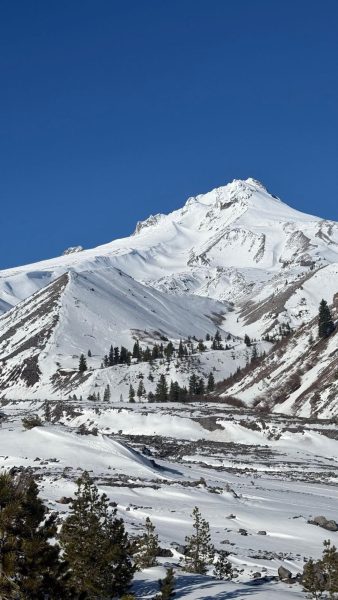
The Dalles has a water right to the Dog River, which feeds into the Crow Creek Reservoir that the city is aiming to expand. Located in Oregon’s Cascade Range, the Dog River is the source of 85% of the city’s water, according to the Oregon Capital Chronicle. April Ehrlich, an environmental reporter for Oregon Public Broadcasting, explains, “By raising the dam, that would allow this large man-made lake in the forest to retain more water, and as it holds more water, it grows and starts encroaching on federal land.”
Oregon Rep. Cliff Bentz initially brought the bill — which would grant the Dalles 150 acres surrounding the current reservoir — to Congress. “Bentz was visiting city officials in The Dalles when they brought up their goal of trying to expand their water reservoir … [due to] a growing population,” says Ehrlich. “Our reporting shows that, although it was a goal outlined [to expand the reservoir] in previous planning documents, it hadn’t been something the city discussed in 20 years.”
DeVoe claims, “This is not drinking water for people. It’s not to satisfy a rapidly expanding population, because The Dalles population isn’t rapidly expanding. This is water for Google’s data centers.” Amie Ell, city clerk and public information officer for The Dalles, counters this viewpoint, stating, “The Crow Creek Reservoir expansion concept also predates data centers in The Dalles by many years.”
The passage of this bill would have a significant environmental impact on the area under debate. “The new pipeline would allow [The Dalles] to dry up the [Dog] River and divert twice as much water [as] they ever had historically,” states DeVoe. Less water leads to fewer fish, specifically salmon and steelhead, which are crucial members of the local ecosystem. “If you take all the water out of the Dog River, you’re reducing the habitat that these fish rely on,” DeVoe explains. Additionally, this extraction of the Dog River’s water could potentially bring temperatures up in the Hood River. “The U.S. Environmental Protection Agency has recognised and identified [the Hood River] as an important cold water refuge for migratory fish on the Columbia River,” says DeVoe. Without access to the Hood River, those migratory fish could dwindle in numbers.
While this bill still sits in Congress, a decision favoring The Dalles could have negative implications for endangered species and the surrounding ecosystem. Ell clarifies that no decisions have been made or approved yet. If or when a decision is made, “Water would continue to be managed through the city’s single municipal water system. It would not be set aside for one user,” states Ell. DeVoe concludes that Google’s water needs are a major factor in the city’s expansion plans, saying, “That’s how we see it. The Dalles may see it differently, and Google, you know, they probably see it differently, but to me, that’s what’s happening.”