

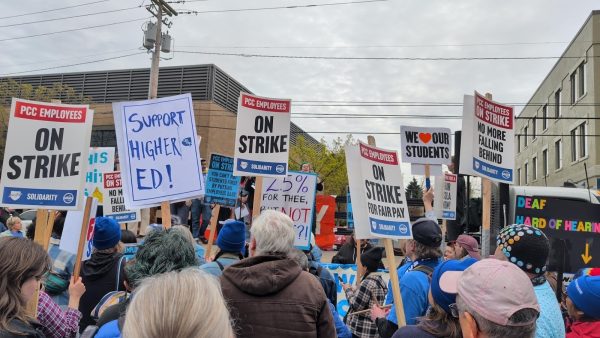
Portland Community College (PCC) employees went on strike on March 11, marking the first community college strike in Oregon history. The strike left students unable to take final exams or register for the spring term, and caused the school to consider pushing back the start of the spring term and subsequently delaying financial aid payments for thousands of students, if an agreement was not reached. Yet, after nearly a year of negotiations and a historic three-week strike, PCC unions celebrated a deal on March 30, announcing on one of their websites, “WHEN WE FIGHT WE WIN!”
PCC unions — the PCC Federation of Faculty and Academic Professionals (PCCFFAP) and the PCC Federation of Classified Employees (PCCFCE) — began negotiations with the school’s administration over contracts in May 2025, with little success. “I don’t want to be striking, I know my colleagues don’t want to be striking. This is an absolute last resort. … [The strike will end] whenever management decide[s] that they want to give us what we need,” said Yvette Rosales, a composition instructor at PCC and the lead steward of full-time faculty for PCCFFAP. The PCCFCE reached a tentative agreement with PCC administrators on March 25, and on March 26, union members voted 82% in favor of the strike-ending deal. PCCFFAP reached a similar agreement with the college on March 30, with 98% of members voting in favor of acceptance. These agreements came just in time for most spring classes to begin on April 6.
Franklin students can earn credits from PCC for dual-enrollment courses, and as the strike occurred during the second semester, this was around the time Franklin, along with other high schools in the area, needed to coordinate with PCC to obtain these credits. The strike’s end means all Portland Public Schools students should be on track with their dual credit enrollment. PCC Dual Credit Coordinator Frank Smith confirmed this, saying, “Outside of delayed support time from our office for dual credit admission and registration questions, there should be no effect for dual credit students.”
Rosales cited rising grocery and gas prices as obstacles with which she and her colleagues must constantly contend. Dissatisfaction among union members was not limited to cost-of-living adjustments (COLA); there were also contentions surrounding course cuts and fiscal sustainability under the current administration. According to Rosales, the last offer made by the administration before the strike was a 0.35% COLA for the 2025-26 school year upon ratification. The strike was set in motion in late February after both PCCFFAP and PCCFCE took a joint vote that found 94% of members in favor of striking. Nearly a week into the strike, negotiations were still stalling, with the administration offering a 0% COLA for the first year, with 4% into the second year. “That’s just not enough, and it does function as a pay cut if COLA for either year is not the same percentage as inflation,” said Rosales. “I think our members deserve something more immediate,” she added.
The current tentative agreement between PCCFCE and PCC administration is a 5% COLA effective July 1of 2026, higher insurance caps, a $1,350 ratification bonus for all workers in the union, new options for Health Savings Account (HSA) rollover, and 90 days of insurance and guaranteed pay for laid-off employees. “Monday, we return to work with the raises, benefits, and protections our members earned through their courage,” said Jeff Grider, PCCFCE president, in a KGW8 article published on March 26. “We urge the administration to meet PCCFFAP’s demands immediately so the entire PCC community can move forward together.”
PCCFFAP’s tentative agreement with PCC was a counter-proposal from the administration on March 29. The college proposed a 2% COLA for the 2025-26 school year, followed by 3% next year, lump sum payments paid in the next regular payroll cycle with $1,400 for full-time faculty and $700 for part-time faculty, increasing the part-time pay schedule by 1%, higher insurance caps, and new options for HSA rollover. PCC administration presented this as “the college’s last best offer,” and PCCFFAP accepted.
The official PCC website claims that the college is facing ongoing budgeting challenges, because, “Over the past three years, expenses have outpaced revenues.” It is because of this deficit that management says they are unable to raise contract offers beyond the agreed upon amounts.
“[The administration] spend[s] $26 million in a biennium on management, and their most recent offer and their COLA offer was just $2 million for careers in a biennium,” Rosales commented on March 16. “Management is super bloated, and there [are] millions of dollars going towards them, so what we’re asking for is absolutely reasonable. This is about priorities, not scarcity.” Rosales is not alone in this sentiment, as the Associated Students of Portland Community College (ASPCC), both unions, and various other students, faculty, and staff have issued votes of no confidence against PCC president Adrien Bennings.
Throughout the three–week strike, there were consistent rallies at all four PCC campuses, as well as virtual meetings for those supporting families or otherwise unable to attend in person. The PCC unions also reached out to state and local representatives to help apply pressure on the administration to meet their demands.
Throughout the back-and-forth of negotiations, striking brought many people together in the PCC community. Rosales expressed that as a teacher, struggles with wages and management can feel isolating, and so the opportunity to find support and solidarity in her community at the picket line was incredibly valuable.
PCC faculty, students, and families have not been working alone; they have an entire community supporting them. From retired teachers driving by and shouting out their support for the rally, students bringing baked goods to share with fellow protestors, and even students from the nearby Clackamas Community College showing up in solidarity, striking PCC faculty have received overwhelming support. While both PCC unions have reached tentative agreements and the strike has come to a close, and staff members can celebrate this victory and prepare to welcome back students for the spring term, PCCFFAP has emphasized, “We did this together. And together, we are just getting started.”