

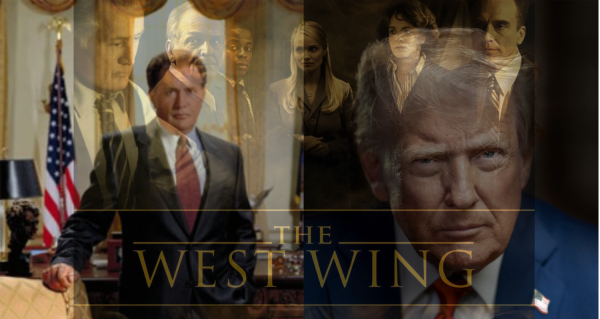
“I am the president of the United States. Not the president of people who agree with me.” This statement, spoken by President Josiah Bartlet in Season 4, Episode 6 of the political drama “The West Wing,” stands in stark contrast to the approach taken by President Donald Trump and his administration today. In an era marked by political instability and unpredictable decisions, political shows depicting stability and genuine leadership, like “The West Wing,” offer a comforting escape for many.
“The West Wing” is a critically acclaimed American political drama that focuses on the inner workings of a fictional Democratic administration. “[‘The West Wing’ is] one of the political dramas that tend to resurface whenever people feel concerned or disillusioned with the current political environment,” says Janel Jett, assistant professor of political science at the University of Oregon. TV series like “The West Wing” and the more-recent “Madam Secretary” serve, for many people, as “political comfort shows,” Jett expresses.
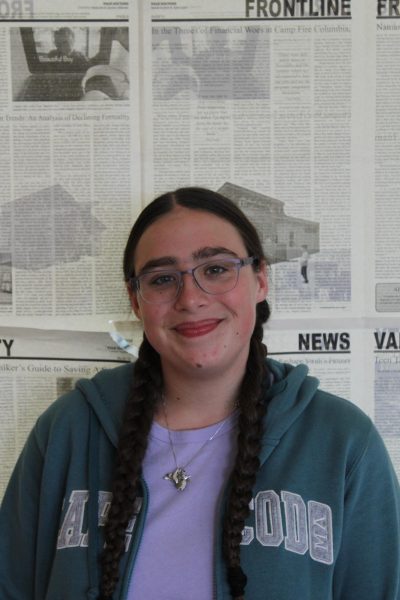
“People search for relatability, especially in times of social and political instability,” says Adeleine Kaye, a Portland-area student and fan of “The West Wing.” “Political TV shows such as ‘The West Wing’ explore real-world issues, show nuance and diverse opinions while keeping lightness and a sense of ‘this too shall pass,’” she comments.
The United States is currently experiencing significant political tension, instability, and polarization. Amidst continually rising gas and grocery prices, heightening global conflicts, and increased Immigration and Customs Enforcement (ICE) activity in major American cities, many people are looking for ways to emotionally escape. For some, this takes the form of TV shows, particularly political ones. Jett says, “These TV shows could generate feelings of order and stability that can feel absent in current politics.”
Public agreement with the government’s actions has dropped to historic lows, with a recent CNN poll indicating only 34% of Americans approve of the war in Iran. Many yearn for a government that prioritizes its people, recalling both real administrations they felt did a better job and fictional ones such as Bartlet’s. A 2024 Guardian article entitled “To watch is to yearn for a different world: how The West Wing made politics feel glorious” encompasses this phenomenon quite well: “We are quite desperately in need of government, at every level, to be even a tiny bit as good as The West Wing believes it can be,” the author writes.
Similarly, an analysis by the Independent found that interest in the show increased in November 2016 and January 2017, coinciding with the first election and inauguration of Donald Trump. “As white Christian nationalism overtakes our country, viewers of the show can see a white Catholic president who is devoted to the rights of the marginalized,” Kaye says. “President Bartlet is imperfect but cares about the citizens of his country in a way that Americans haven’t experienced in a long time. I think that the imperfection of the show is where the comfort lies because it shows an administration devoted to righting their own wrongs.”
Another show that mirrors a similar effect to “The West Wing” is “Madam Secretary,” which follows the Secretary of State, Elizabeth McCord, as she navigates diplomacy and ethical crises while balancing her family. A Paste Magazine article entitled “‘Madam Secretary’ Is the Ultimate Form of Political Escapism,” notes that “the defining feature of ‘Madam Secretary’ is its almost fantastical calm,” something that is absent from real-life politics right now.
The political comedy “Veep” is also very similar to “The West Wing,” being described as its “cynical counterpart,” by NPR. This show follows Vice President Selina Meyer and her staffers as they prioritize image management over actual governance. Meyer grows more cynical and disillusioned with her role, which is not how she imagined it would be. A Vanity Fair article highlights that the show has “become pop culture code for political hypocrisy and bumbling.” In the same article, David Mandel, the show’s creator, says that, “Our greatest efforts to turn Selina into the worst president in the world were easily outdone by Trump.” He notes that the show ended largely because, “So much of it was based on the notion that there were consequences to what you do and say as a politician, and that just went out the window with Donald Trump.”
Reviews of “The West Wing” from Google and Rotten Tomatoes reveal its enduring appeal, with many viewing it as an idealized version of how the government should function. Comments express this longing sentiment, reading: “One could only wish that this was the way our federal government worked,” “Imagine if we had a leader like that in the White House?” “The best president we never had,” and “How much better would the world be now if the White House had a Bartlet administration?”
However, Jett notes that watching shows such as “The West Wing” can do more than just provide hope and escape from current realities, and that they can be “a form of political engagement and meaning-making.” She also comments that, “Viewers of these shows aren’t just escaping reality; they’re using fiction to process concerns, develop civic ideals, and engage with political ideas.”
It is well known that for many people, TV is a form of escape, though Jett says, “Viewers likely choose political dramas not to avoid politics, but to process political realities safely and thoughtfully.” She continues, saying, “Political TV may [likely] function as a bridge into political interest rather than a detour away from it.” As one reviewer on IMDB puts it, “One could only wish that this was the way our federal government worked.”