

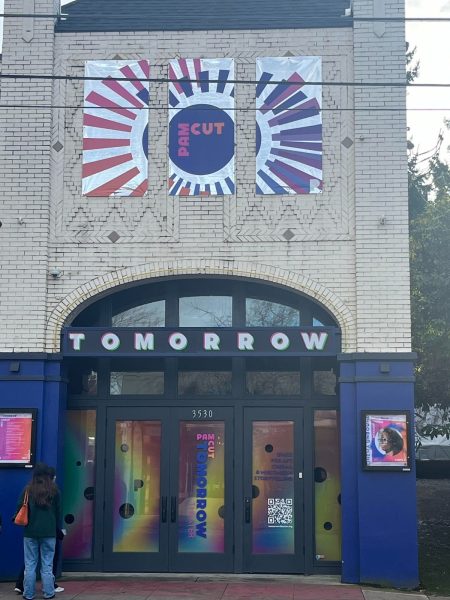
The Tomorrow Theater in Southeast Portland embraces artistic identity in every form, straying from the traditional and embracing countless mediums and mash-ups. While the theater screens movies in a traditional sense, they often contain a twist or extension. “The Tomorrow is a plus-plus model,” explains Amy Dotson, director of the Center for an Untold Tomorrow, the organization that runs the theater. Dotson herself manages many aspects of the theater, from curation and organization to greeting visitors at the door. She explains, “It’s dance, plus comedy, tattoo artists, and a punk rock band.” Whatever the combination, shows are guaranteed to entertain, and the interactive components add excitement and engagement beyond the scope of a regular movie theater.
The Tomorrow averages about 180 nightly visitors, drawn by a wide range of performances and events. The theater often incorporates themed viewings, like Millennial Movie March Madness and Vamp January, with each event drawing new and unique audiences. “What I love most about the space is that when you walk in you never know what to expect, and you never know who the audience is going to be,” says Dotson.
Pricing for general screenings falls around $15, but admission is free on the first Thursday of every month from 10 a.m. to 7 p.m., making it more accessible to everyone. Pricing increases for the Carte Blanche series, an open stage for a featured guest. “We ask an awesome, unbound artist to come in, and they have carte blanche to talk about whatever they want,” explains Dotson. “Give it to somebody like David Byrne, he might come in and talk about affordable housing … [and when] we had Miranda July, she talked about non-sexual intimacy, and started changing clothes with different audience members.”
While a wide variety of artists are featured, highlighting local and Pacific Northwest creators is a strong priority. The Tomorrow Theater commits to ensuring local representation at least four times a month, but it’s often more. “That ranges from the McDaniel High School’s Stop and Step team … [to] somebody whose film just premiered at Sundance and they happened to be local,” Dotson says.
The theater’s location is deeply rooted in Oregon history. The building was constructed in 1925 as a vaudeville theater, and later went on to screen Hollywood, art-house — films that are artistic and experimental, and Spanish-language films. In the 1970s, it became the Oregon Theater, Portland’s longest-running adult cinema venue. When the Oregon Theater went into foreclosure in 2020, the Portland Art Museum was approached with the concept of an extension of the museum.
The theater was then rented and renovated in a process that took around 8 months. During that time, the space was stripped down to the studs. The couches formerly used as seating were removed, explicit posters torn down, and the renovation process began, reimagined by local company Osmose Design.
Andee Hess, owner and founder of Osmose Design, details the lengthy process. “We didn’t [technically] change the use of the theater,” she explains. To create a more functional space, a stage was added, along with fixed seating, restrooms, and a ramp. “The inspiration of the theater was Pee-Wee’s Playhouse meets Vivienne Westwood,” says Dotson. This effect was achieved in part by the unique puppet-theater-inspired concessions stand selling mocktails, pizza, and cake bombs, and colorful fabrics draped along the walls. “It’s lived a lot of lives, so we embraced that, when you walk into the theater, if-you-know-you-know, and there’s a giant day-glo mattress hanging from the ceiling,” Dotson adds. A neon ‘Oregon’ sign also pays homage to the theater’s past.
The Tomorrow Theater officially opened November of 2023 and has already become a cultural staple of Portland. Whether you’re looking for cinematic productions, outside-the-box experiences, or a sense of community, the Tomorrow Theater will deliver.
“[The Tomorrow Theater] is a really special place because we have a good time,” says Dotson, “and I think at a moment when the world is complex and sometimes terribly depressing, joy is really important.”