

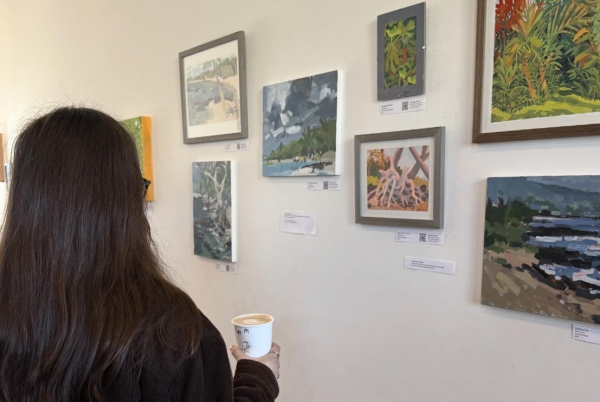
In a city where coffee is a central part of its identity, Portland’s local coffee shops are more than just places to grab a latte or meet up with friends on a chilly Saturday morning. In some cafes, rotating art displays have quietly transformed neighborhood coffee shops into community galleries, giving local creators an accessible and welcoming place to shine. What began as aesthetic enhancements of cozy spaces has grown into a way for small businesses and artists to connect with the city’s residents.
Albina Press, a local Portland coffee shop with locations on Southeast Albina Avenue and Southeast Hawthorne Boulevard, switches out their art displays every two months. Emily Wise, the art coordinator for Albina Press, said that she “want[s] the work to be up long enough for as many people to see it as possible, … but not so long it gets boring.” Different coffee shops may keep art pieces for varying lengths of time. This constant renewal keeps regular customers engaged and gives a wide variety of creators the opportunity to display their work. One month, a cafe might show a watercolour inspired by Forest Park; the next month, there could be bold, abstract pieces or black and white cityscape photography.
Portland communities have long celebrated artists, from potters to painters to poets, so it is no surprise that these displays are becoming increasingly common. Coffee shops, many of which are locally owned, embrace the spirit of creativity by opening their walls to the artwork of the people who live nearby, resulting in a shifting landscape of shapes and colours. Ty Ennis, owner of Old Friends Coffee Roasters and longtime Portland artist, recognizes this, and proudly stated that “Old Friends is a cafe first, but it is also a meeting place for artists and creatives and a place for folks to both show and experience work.”
For students, these cafes may prove to be especially valuable, as showing creative work outside of classroom studios can be a major step. Having artwork displayed in public spaces like cafes can boost confidence and offer real-world experience that goes beyond assignments or portfolio requirements for student artists. Ennis, who had his first art show in a cafe while he was in high school, noted that younger artists are encouraged to showcase their work, saying Old Friends would “definitely be into … showing the work created by high school students.”
For student artists, having their work on display also creates opportunities for meeting other creatives and becoming part of the communities that form within these cafes. Their pieces can spark conversation between local artists and regular patrons alike, helping them to build connections in a setting that feels relaxed rather than awkward. As Ennis explained, “I’d rather not use the word pretentious, but the goal is to have a creative space without any pretentiousness.” In this kind of environment, students can engage with others more comfortably, making it easier to learn from peers, seek advice, and feel welcomed into the local arts scene.
These cycling art displays have a practical purpose: they give cafes personality, create welcoming atmospheres, and support local artists. At both Albina Press and Old Friends Coffee Roasters, artists have the opportunity to sell their work, on top of displaying it. Wise added that “artists almost always sell [their] work” while collaborating with the coffee shop. And, instead of waiting for a gallery opening or museum weekend, artists get to show their pieces in casual settings, while patrons get to enjoy creativity in more mundane moments. This can make art feel more accessible and less intimidating.
These displays also help foster a sense of powerful sense of community, bringing different people together in the same creative space. As Ennis put it, “Since we are as connected to the art world as we are, it makes sense to utilize that connection to bridge the cafe and art communities we know so well.” While galleries and museums remain essential as spaces for curated, professional, and large-scale art, coffee shops have the potential to expand this creative ecosystem. They can make room for voices that may not yet be fully established, and remind us that art can make an impact in the everyday spaces we occupy.
The next time you walk into a Portland coffee shop, take a second to look at any art that may be on the walls. Each piece carries its own story, shaped by the artist’s perspective, time, and technique. One might come from a seasoned painter with decades of experience; another from a student just starting out. More than anything, this community mix reminds us that creativity can thrive anywhere when given the chance.