

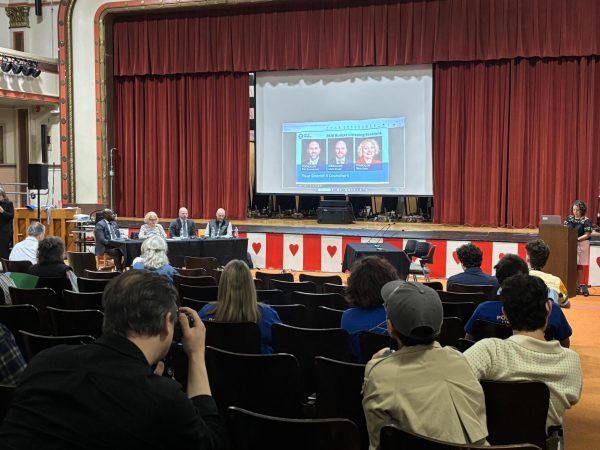
On Monday, April 20, Portland Mayor Keith Wilson announced his proposed budget for the City’s 2026-27 fiscal year, which begins on July 1. The proposed budget sits at $8.5 billion and aims to close the $171 million general fund gap. Portland’s City Council now begins the review of the budget, which its 12 members will approve by May 20. The Tax Supervising and Conservation Commission will take on another step of the review process, before the budget is officially adopted by the City Council by June 17.
The general fund’s discretionary resources are the city’s unrestricted money, primarily raised through property and business license taxes, and utility and franchise fees. It is generally allocated to fund basic city services like police, fire response, and parks.
The budget gap is the product of the $162.9 million required to sustain the current service level, as well as $8.7 million in proposed additions that were not previously accounted for in next year’s expected revenue. The proposed budget resolves this through the transfer of $44 million from reserve and contingency funds, raising new revenue, and reductions to many bureaus. According to a press release on the budget, all 31 fire stations, community centers, and city parks will remain open, and every police officer and investigator will keep their position under the proposed budget.
This review process is part of the legal requirement for the City Council to approve a balanced budget each year, meaning the planned spending — based on the services the city currently provides and additions for the next year — must be equal to the revenue the city expects to bring in.
The proposed reductions included in the budget are the main source of the surrounding contention. “The reductions from [the] current service level are essentially a bureau-by-bureau thing,” explains Alison Perkins, a public information officer with the City of Portland. The budget will eliminate 145 total positions across the city, and resources for many bureaus — including Portland Fire & Rescue (PF&R), the Portland Police Bureau (PPB), and various resources combating houselessness — will face budget reductions.
The proposed budget for PPB comes in at $319.6 million for the upcoming fiscal year, marking a 6.3% overall budget reduction from the current service level. Within that, there is a 7.8% reduction from the general fund, which makes up the majority — but not the entirety — of PPB’s budget.. This scales back external materials and services by 35%, or $5.89 million; reduces the non-emergency, alternate response Public Safety Support Specialist program by 80% or $4.51 million; and downsizes $3.48 million through reducing fleet expenses by 20%. This is coupled with a reduction in technology duplication and backups.
“The proposal on the table currently will have a detrimental impact both on the Police Bureau and the level of service we’re able to provide,” commented PPB Chief Bob Day in an April 23 press conference regarding the budget cuts. Concerning the cuts to the public safety program, District Two City Councilor Elana Pirtle-Guiney states, “It seems like [the Mayor] is going to ask police to take on that work, which will actually cost more than just having the staff who are there now.”
Regarding another aspect of the city’s public safety services, the proposed budget for PF&R is $216.2 million, a total reduction of 3.9% from the current service level, including a 5% general fund reduction. The elimination of one full engine was proposed. Additionally, three two-person medical rescue teams would be shifted from 24 hours to only peak emergency times.
In response to these changes, Rick Graves, PF&R public information officer, says the reductions “will increase the time it take[s] to arrive at an emergency, and it also means the folks on the line will be performing more emergencies that could lead to fatigue and burnout.” Pirtle-Guiney comments that she has heard concerns from her constituents in the St. John’s neighborhood about losing a fire engine at the area’s Station 22 — a budget shift that District Four City Councilor Mitch Green similarly remarks he is “really worried” about.
Along with other offices in the Public Safety Service Area, Portland Street Response, the city’s civilian first-response agency, will experience cuts. The proposed budget will cut four full-time positions, all of which are currently vacant, from their Aftercare program, which provides follow-up support after initial crisis response. The program will maintain its operation schedule and is in a “good, stable place for the moment, despite the budget deficit,” according to Stephanie Howard, Portland’s Public Safety Service Area director of community safety.
Despite the cuts to government programs across bureaus, all of Portland’s 156 parks will remain open. However some reductions will be made to maintenance, programming, and security, among other things. Pirtle-Guiney explains that the parks levy — a property tax passed in November of 2025 — helped to save some of Portland Parks & Recreation’s funding. “Like we promised in that levy, we are saving regular cleaning in our parks, regular maintenance in our parks; all of the community centers and parks are staying open,” she says.
Portland Solutions, the city’s centralized program hub to address homelessness and livability issues, has a proposed budget of $65.6 million — a 21.4% reduction from the current service level, including an 8.2% general fund reduction. “These reductions stem from the loss of shared regional funding and the need to realign resources,” says Mayor Keith Wilson in a statement to the Post.
A major change in Portland’s homelessness policy is the decoupling of the city from a joint response relationship with Multnomah County. The city has previously sent money to the county; this money — $30.5 million — is now being realigned to city shelter programming. “The city is shifting away from exchanging funds with Multnomah County and concentrating its remaining dollars on direct outreach and core shelter operations,” comments Wilson. “Even with the cuts, the budget maintains the city’s commitment to preventing a return to unsafe and inhumane conditions for people living unsheltered.”
The proposed budget is just an aspect of the city’s larger financial situation. “We’re basically in a financial crisis,” explains Green. “We have to have a long-term view of things, because if we budget year by year, we might get ourselves in a situation where we’re making that crisis worse.”
A variety of listening and work sessions, as well as City Council meetings on the budget, are set to continue until mid June. Angelita Morillo, City Councilor representing District Three, expresses that constituent feedback at listening sessions is “hugely helpful, because there are things that we just don’t know are priorities until people come and tell us.” Additional information about these sessions, which are open to the public, can be found online at portland.gov/budget/join.