

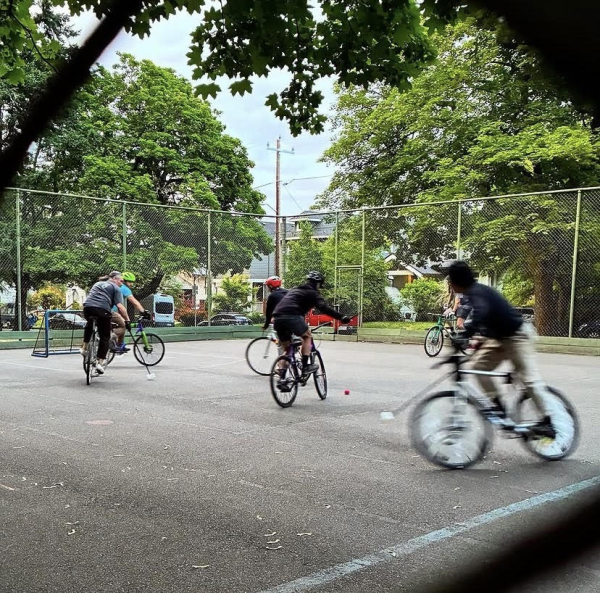
The reins are pulled, weight is shifted, and one hand swings the mallet, propelling the ball forward along the grass. Only, the reins are brakes, the horse a bike, and the grass an asphalt court. This is hardcourt bike polo, a fast-paced sport where players balance on bikes while using a mallet to try and hit a ball into the opposing team’s net. It’s typically played three-on–three and ends when one team scores five points, and greater difficulty is added with restrictions on making contact with the ground. The rules differ depending on whether it is played on grass or on a court, and the hardcourt version has become more common in the modern day.
Bike polo was created in Ireland in 1891 by Richard McCready, though the original version was played on open grass fields. Hardcourt bike polo was not invented until the 1990s by bike messengers Matt Messenger, Jay Grisham, and Tim Mason in Seattle. Messenger, also known as “Mess Man,” is credited with being one of the first players and helping develop bike polo into the sport it is now. The game has been adapted to be played in parking lots, on basketball courts, and in alleyways. As knowledge of the sport spread, the first bike polo clubs began to form, with the first tournament in Portland being played at the West Side Invite in 2003.
Portland Bike Polo, a sports club based in Alberta Park, has played a significant role in shaping the sport. “They used to play with traditional wooden mallets up in Seattle and Vancouver, but Portland was the first club to start using ski poles for mallets,” says Jordan Bailey, the owner of Heckler’s Alley, a bike polo gear shop in Portland. Additionally, Portland players influenced the use of street hockey balls rather than the traditionally–used tennis balls, created Podium Bike Polo — a website used to track tournaments — and created disc guards, a covering to protect bike brakes.
The Alberta Park court was not always used for bike polo; it originally served as a tennis court. “It was slated to be torn down because it was in poor shape, but then the [bike] polo club and the [street] hockey players got together, and were able to petition the city to just leave it alone,” says Sean, an avid member of the club who has been playing bike polo for over two years.
“Recruitment is something that we’re always trying to do, but we’re never successful at it,” says Bailey. Despite efforts to gain the interest of local bikers, around half the players in the Portland club moved here from other U.S. states. Sean recounts around one to two new players coming to games during the summer each week. “We would love to have some fresh blood,” Bailey adds.
When first getting into bike polo, some players can struggle adjusting to the new skills required, such as “hand-eye coordination, having to ride a bike one-handed, and try[ing] to tap a little ball on the ground, that’s pretty hard,” says Sean. Still, both Sean and Bailey have positive attitudes toward developing skills and a passion for the game.
“It’s amazing how quickly the body’s coordination adapts to this kind of game, which is completely different than anything [it has] done before,” says Gavin Simmons-Feigel, a bike polo player based in eastern Canada, who is a part of the Northside Polo Podcast. This podcast, run by Simmons-Feigel along with two other members, is dedicated to bike polo news, strategies, and technicalities.
There are several different options for bike polo gear, though some provide greater advantages than others. For example, using a mallet with a shorter head and lighter handle creates greater ease for maneuvering the ball, according to Bailey. Additionally, the technical difficulty of the game can be adjusted from club to club. “Usually people think they can’t do it because they don’t know how to ride a fixed gear [bike], but we play on single-speed bikes, [which are] much easier than playing on fixed gear [bikes],” says Sean. Rather than using fixed gear bikes — which have pedals that move whenever the wheels do — Portland Bike Polo players most commonly use bikes that allow coasting.
How did bike polo spread so far and so quickly? The answer may lie in its engrossing nature. “I have the want [and] need to eat food, and sleep, and work, and have a family. And I need to balance that with this entire other motivation, which is just to play as much bike polo as I possibly can,” says Simmons-Feigel. “I’ve just found that that flow state, the level of attention you need, and the dopamine that comes from … that intermittent success is just so worthwhile, [and] so valuable for me.” Additionally, both Sean and Bailey express satisfaction from scoring a goal after a good play and spending time with positive teammates.
Bike polo has gained a rapidly expanding following, not only in the United States, but worldwide. Portland specifically holds an important history with shaping the sport and keeping it alive through the Portland Bike Polo. “Even if you don’t love it, you’ll learn something from it that will be meaningful and valuable for you moving forward. I really encourage everyone to try bike polo at least twice,” says Simmons-Feigel. The next bike polo tournament occurring in Oregon is the Jefferson Joust 7 at Hunter Park in Ashland from June 6 to 7.