





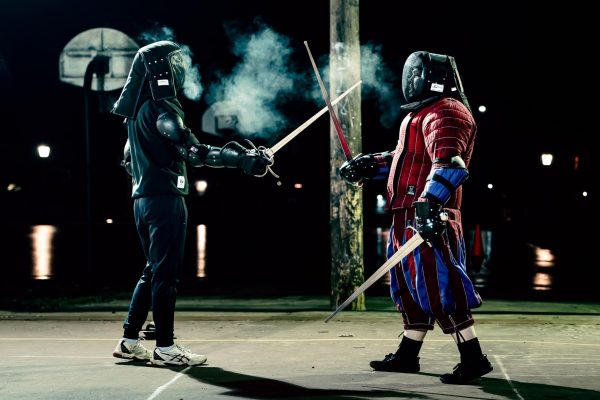
The shrieks of clashing swords rise above the clamor of battle. The opposing fronts join into a fierce melee as the brutal campaign escalates. A thud, a crash, a strike — the series of hits intensifies as two armored knights duel. And then, with a final, masterful blow, cold metal slips through armor into tender flesh. The fallen knight is subsumed by the roaring of a thousand more soldiers.
“There [are] things that make me wonder, would I actually be okay back then?” ponders Christopher Burns of his chances of survival and success if dropped into a medieval battlefield. Burns, who goes by his viking moniker Sir Valdemar den Ivrige when he teaches, is the director of the Portland- and Los Angeles-based Fight Like A Knight medieval combat school. He’s been swordfighting for 36 years. “Maybe they knew stuff that I haven’t even thought about that would destroy me in a heartbeat.”
The armored fights of the past were bloody affairs, documented in oral history, art, and manuscripts. These records preserved technical concepts that inform the world of modern medieval combat today, a sport that blends careful historical accuracy, practiced maneuvers, and bruisingly-heavy weaponry.
Multiple medieval combat organizations exist in the Portland metro area, including Fight Like A Knight, which meets at Gabriel Park in Southwest; Bridge City Blades, a Historical European Martial Arts (HEMA) club in Southeast; Academia Duellatoria, a school of Historic European Swordplay in Beaverton; and Indes Ferox Gladio, a club in Southwest. Each club has developed a unique culture, but they are connected nonetheless; former students of one club might teach at another, and schools might spar against each other.
“The sporting aspect has always existed alongside [actual combat] as a way to practice without hurting your friends. You have to be able to practice, but you don’t want to kill the people you’re training with,” explains Jeff Richardson, instructor at arms at Academia Duellatoria. The difference between fighting in a battle and fighting for practice? “Mindset,” he states.
Practical safety measures divide the modern sport from the battlefield. “As far as the brutality of it goes, the way we play is not authentic when we spar,” says Burns. “If it were a real sword fight, I would be stabbing, and trying to trick you and kick you and whatever I could do to win, because it’s life or death, and those things tend to get very dangerous and injurious. So we don’t allow those kinds of things.” Competitors avoid aiming below the knees, where the close-to-the-surface tibia could be badly injured — Burns compares the striking force of the sport’s weapons to a baseball bat. Still, the sport, especially at the level at which skilled participants compete, doesn’t shy away from brutality. “Plenty of times people will walk away with these massive bruises and contusions from getting hit in soft spots of their body,” says Burns.
Richardson himself joined HEMA through a somewhat typical path — if anything in regard to the sport can be described as typical — through the broader world of medieval recreation. Coming from a background in fencing, Richardson initially connected with the historic recreation scene before realizing his specific interest in the combat angle. The major historical recreation groups in the United States — Burns and Richardson specifically mention the Society for Creative Anachronism (SCA) — aren’t necessarily pinpointed on fighting, though Burns calls it the “most high-profile aspect.”
“It’s kind of a niche thing. Aside from about two or three tournaments in the country, it’s not really well publicized,” says Richardson. “So if you’re not tied into the community, it’s kind of easy to miss.” Burns reflects something similar: “You’d have to stumble across it,” he says. Once you do, it’s “full contact, full speed, and it’s not choreographed.”
The modern sport is an offshoot of historical recreation; in some cases, HEMA clubs were even founded out of SCA groups. Thus, accuracy is a constant consideration. “We look at these books called treatises that were teaching people to fight on the battlefield,” explains Andy Plymate, lead instructor at Bridge City Blades. “The historical part is looking at how people used these weapons in their time.” The historical sources range from scanned original documents and translated works, covering niches like German judicial dueling — see the Talhoffer manual — the broad strokes of technique, and also some step-by-step instruction drills.
In some instances, sources are hard to come by, or available ones are not relevant to the specific kinds of fighting a club is trying to emulate. “It’s hard to find things, especially from the era that I’m teaching from,” comments Burns. So, the swordfighting gets creative. “In the mid-60s, [some original SCA people] went down to the meat packing plant and threw some chain mail over a side of beef and started hitting it with a sword,” explains Burns. The question that motivated this venture was, “What do we have to do with this weapon to kill the meat underneath this armor?” They found that the moves seen in movies and media didn’t work, as they were too tiring or not effective enough to get through armor. “We just had to get out and start figuring it out and relying on our knowledge of things,” explains Richardson.
Their equipment shows a similar pursuit for functional tools that allow historical accuracy. “[The plastic in my armor] is all either covered by leather, or there’s metal around it, or it’s hidden underneath outer clothing so that you don’t see it. I get the benefit of the protection, and it is lightweight, but nobody sees it,” explains Burns. “It still looks like I’m walking out of a history book.” Sometimes local blacksmiths will craft the most visible parts of armor — arm plates and helmets — but not all participants need to commission their armor. “I got plenty of [beginners who] come out with football gear or motocross gear,” says Burns.
“Most gear is made from modern materials such as plastics, resins, kydex, etcetera, although you’ll regularly encounter ‘purists’ who do everything they can to keep their kit authentic,” says Joe Colistro, one of the founders and current president of HEMA club Indes Ferox Gladio. “This will include leather, hand-stitching, cotton padding, and the like.” Different competitors have different perspectives on the importance of historical accuracy in their gear. Colistro explains, “At the start of HEMA the idea was to keep everything ‘black’ to differentiate us from modern fencers, but the fashion scene has really exploded over the last seven or eight years.”
As for weapons, different kinds of materials are used as training swords, including rattan, a lightweight kind of grass. In combat, spears, pole axes, and blunted steel swords, which weigh two and a half to three pounds, are all part of the repertoire. “We used to train with sharps, but I ran out of students,” jokes Richardson.
Plymate’s personal mantra is “Chess at Nascar speeds”: the intensity of a battle can only exist with strategy from both players. At tournaments, people fight to score points, with different parts of the body representing different point values. The head and chest are deeper targets that hold a higher point value, explains Plymate. While these tournaments can be intense, he describes a sense of camaraderie among teams from the Pacific Northwest, saying, “It’s non-territorial. We all have our clubs, but we love the sport, too.”
During fights, opponents need that mutual trust and love of the sport. “The nature of the fighting is based entirely on honor and chivalry,” says Burns. If you and I are fighting and you hit me with a blow, I’m the one who tells you you’ve won. … It’s up to [the opponent] to tell me that I did a good enough job to have won the fight.” Burns sees these values of honor and chivalry, embedded in the game, as creating its beauty. “You wind up with a really great group of people who care more about each other and having fun with another person than they do about winning and losing,” he explains.
Despite its esoteric status, medieval combat draws a varied crowd. For some, like Burns, it plays into “people’s romantic view of the Middle Ages, [like] imagining yourself [as] the hero with the sword and saving the prince or the princess and slaying the dragon.” He says the people who stick with it are “enthusiasts,” interested in both the historical and physical aspects — and are able to get over their initial hesitancy to hit someone. “People are a little afraid to hurt someone else,” says Burns. “[So] I will put a helmet on and just have them hit me over and over … until they get to blow strength. By that time, they’re like, ‘Oh, I can do that.’”
The intention that prepares competitors for swordfighting culminates in scenes of glorious armored battle, displays of strength and strategy found nowhere else. “We’re not trying to play tag with a sword, we’re trying to reenact,” comments Plymate. The history of brutal combat informs an activity that values honor and its diverse participants as much as accuracy. Richardson sums it up: “I’m looking for a unique way to look at history, to learn about things in ways that your textbooks don’t necessarily reveal to you.” Peering through the openings of a helmet, sword in hand, perhaps this new perspective can be gleaned.


Christopher Burns • Apr 24, 2026 at 9:38 am
Great article, Norah! You captured the essence of what we all do, and why we were drawn to it eloquently, accurately, and in a highly readable/entertaining manner. Thank you for this!