

Today, we live in what some consider a genreless society. Throughout past decades, there have been distinct sounds that dominated the mainstream, which later became reminders of the era. However, with the internet and the unlimited access to media it allows, listeners today can find any sort of genres, eras, and sounds, which makes it easier than ever to discover things that interest them.
Many more artists are now able to get their works out into the world, and they are more likely to find their audience. The internet can make the difficult process of launching a full media career much easier. Many artists, especially those who produce beats, use platforms like Instagram and Soundcloud to promote their music.
Genreless? If you know where to look, high school-aged amateur producers are finding their own sounds, far away from the common melodies of pop music, even here at Franklin.
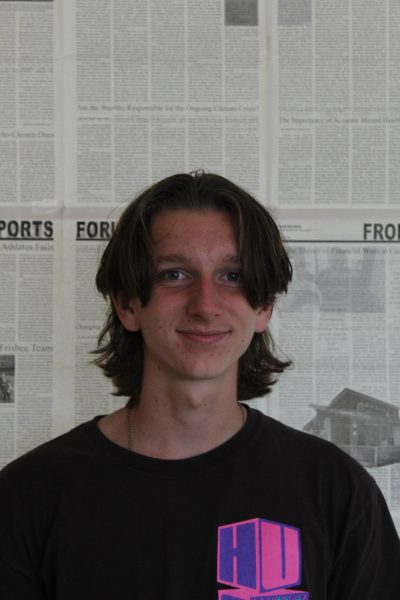
Perry Rall, a senior at Franklin, is an avid producer known as prod.peregrine on Instagram. He decided to start producing when he saw some of his friends experimenting with it. “I thought it was a lot of fun, so I made a BandLab account and started trying to make [beats].” Today, he uses FL Studio for synthesizing his music.
Rall works on his beats five days a week. “I do want to start doing that more though because I’m trying to be on the placement grind,” he says. A “placement grind” is when “you’re trying to send your beats out to artists, small or big, and just trying to get them to use them.” Rall has had beats sent to artists like 21 Savage and SZA. “It’s a lot easier than you think,” he says. “I’m in this Discord server and the dude who runs it is like three times Grammy nominated. He’ll do a thing called ‘boot camp,’ and you can submit something each week. Each week he goes through them, picks out the best ones, and sends them out to big artists.”
Noah Gumke is a senior at Cleveland High School, and produces music under the name noalot. Like many, Gumke started experimenting musically in late elementary and early middle school, “just messing around on GarageBand.” Though Gumke has been creating consistently for the past three years, he explained that making money off of his music is not his main motivation. “If I knew for a fact that I wouldn’t ever make any good money off this or even get that much recognition, I would still do it because I enjoy it,” he says. He also doesn’t have any famous artists he would necessarily like to work with. “A lot of the music I do make is either on my own or with people I’m already friends with, and I’m fine with that.” There are many artists that take pride in being underground or relatively known; of course there is nothing inherently wrong with seeking success, but many choose the local intimate fan base and collaborators over the commercial buyout.
Finn Stewart is a student producer who goes to Benson Polytechnic High School, and his producer name is finn267990. “I didn’t really know what to name myself. I wanted to be Finn, but I think there’s some other Finns out there that are producers … I have those numbers [at the end of my name] but I lowkey don’t really know what they mean, but I think I’m gonna try to find meaning in the future,” he says. One of his biggest self–proclaimed accomplishments is finding his own niche sound. “I’ve recently been doing more EDM,” he says. “My beats kind of sound like the 2023 ambient stuff.” Stewart also mentions that, while he is still growing as an artist, he doesn’t seek fame. “I would not like to have 3 million, 5 million monthly listeners because I feel like people would only be around me because I’m that person.”
People take a lot of pride in the niche or underground artists that they follow. One reason for this is that a lot of modern mainstream music is heavily marketed and curated to appease as wide of an audience as possible. This is what separates the growing base of young producers from the current popular music scene. The mainstream is made and marketed to draw in and keep as many listeners as possible, sometimes at the risk of a homogenous sound, while many high school producers are more interested in finding their own sound. Art is its most appealing when it is authentic, and made without thinking about others’ opinions on it.
Anyone is able to produce and market their own music which makes this genre built by amateur producers so unique. You don’t need any instruments; only a computer and a will to create something new. Fellow classmates may take pride in knowing that they are of a select few that get to enjoy your music, which can be much more fulfilling than commercial success. This is why the underground music scene can be, and is, so special to artists and listeners alike.