

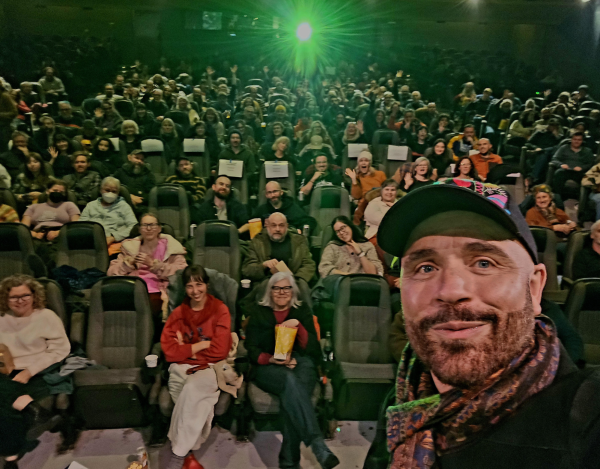
Stepping into the Hollywood Theatre in Northeast Portland feels like being transported to a different time. Walking up the velveted hallways lined with vintage movie posters before sitting down with popcorn, full of anticipation for the upcoming movie, begs the question: “Why don’t I do this more often?” Fortunately, a plethora of opportunities for this experience are offered by the Portland Ecofilm Festival, one of the theatre’s signature events. The festival, which also takes place on select dates at Cinema 21 and the Clinton Street Theater, aims to foster a community appreciation for the natural world. Conveniently happening around Earth Day, it offers a chance to celebrate the environment while uplifting independent film through independent theaters.
Running from March to June, the Portland EcoFilm Festival offers screenings of both feature-length and short films, which cover a broad scope of topics and genres, but all center around a common theme. “It started out more environmentally specific, [but] now encompasses what I would call a more expansive definition of ecology rooted in the fact that ecology means knowledge of home,” explains Rozzell Medina, director and programmer of the festival. Medina, who has a background in both the arts and environmental education, has been directing the festival for the past five years.
He also leads the festival’s Film and Awards Curation Community, which works through the hundreds of films that are submitted from around the world annually. He explains that this process is the hardest part of the event. “There is some pretty heavy subject matter in terms of the films that are submitted,” says Medina. “Carrying that sort of emotional weight can be a challenge.” He emphasizes how it can be difficult to choose which films to select, saying, “We rarely receive what I would call an unimportant film.” Members of the curation community can be of any age and from any place, with the main requirement being “a passion for and knowledge of cinema and ecology,” according to the Portland EcoFilm Festival website.
The curation community also selects which films receive awards, including the Black Merlin Visionary Film Award, EcoHero Award, and Best Conservation Film. Beginning this year, audience members can vote for audience awards when they attend certain film screenings. The 2026 Best Feature Film winner is “COSMOS,” directed by Germinal Roaux. Set in the Yucatán Peninsula, “COSMOS” is part of the festival’s Indigenous Voices Series and features 146 minutes of gorgeous black and white cinematography.
In addition to full-length offerings such as “COSMOS,” the Portland EcoFilm Festival presents several collections of short films. The “More than Human” program, which is screening on April 30, features seven films that highlight human-to-nonhuman connections. Included in this program is “Fish for the Future,” a five-minute documentary that covers efforts to preserve the Southern Steelhead Trout population in the Topanga Creek outside Los Angeles, which was devastated by the Palisades Fire of January 2025.
“Fish for the Future” director Matthew Benton provides a perspective from within the filmmaking process. “I always want to make films that leave people inspired and illuminated, with these stories that usually go … unnoticed or unheard. You might read an article or [listen to] podcast or a story about these fish rescues, but to really see it happen, it really adds that context.” Medina agrees with this sentiment, saying, “I really believe in the power of cinema to help us co-create a more ecological consciousness.”
With the ease of streaming from home or scrolling for hours on social media, viewing a film in person can feel like a refreshing change. “Some films break our hearts, some films show us the devastating cost of something, but I hope that a lot of films leave people with hope and maybe joy to do something different or to at least continue to do the work that they’re already doing,” says Benton. Medina encourages young people to attend the festival, saying, “If anyone wants to get involved in any way or has any sort of barriers to attending films, they can always check out the website or get in touch with me.” For those over the age of 18 who are interested in learning more about independent film and the intersection of art and the environment, the Portland EcoFilm Festival offers a free college credit course called Multnomah Clemente, taught by Medina himself.
The seemingly simple adventure of going to the cinema rewards viewers with a sense of connection — to fellow audience members, to the stories being told, and, in this case, to nature itself. “It’s really just about making people get off the doom scrolling and just engage in their community. Meet your neighbors and protect the local flora and fauna,” says Benton. So, in the spirit of Earth Day, go watch a movie.