


“DODGEBALL!”
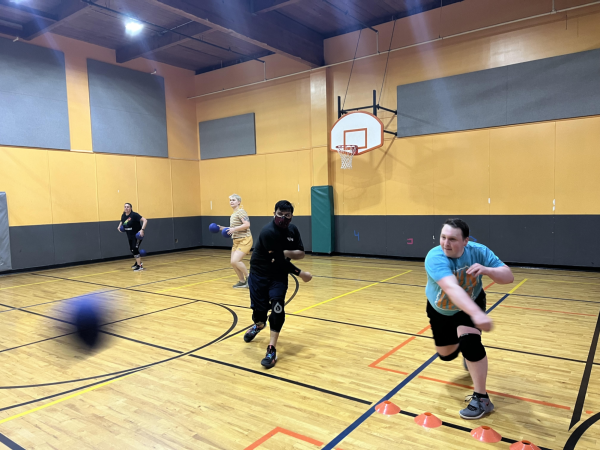
The referee shouts and the game begins. A mad dash to the center line. Shoes squeak on the court. Knuckles turn white, locked in a tight grip. Balls ricochet. “Out!” Love it or hate it, few sports can rival the pure pandemonium of dodgeball, and for two Portlanders, it brought a passion that has taken them on tour around the country.
“I got into dodgeball on a lark,” says Kyle Ashby, the executive director and president of Dodgeball PDX. “My friends and I all made an agreement in our mid-30s that we weren’t going to go to the bars as much anymore. We all said ‘okay, we all bring one new thing to the table, we try it out and see if any of them stick.’”
“We went out and we just played one night in 2019,” says Nick Keller, the director of operations at the Rose City Dodgeball Association (RCDA). “There was no intention to play any longer, but we loved it. I think I couldn’t lift my arm after the first day, and somehow I still decided to go back week after week from then on.” Ashby had a similar experience. “I was immediately hooked. It was a life changing event for me.”
Since then, the duo have been building Portland’s dodgeball pyramid, giving league play opportunities for beginners all the way to nationally ranked professionals.
Ashby runs the base, trying to draw in as many players as possible. Dodgeball PDX hosts open play, rec leagues and a queer league. All of their events are held at their home location, the Friendly House community center on NW 26th avenue.
“Our mission is to increase the visibility and accessibility of dodgeball within the state of Oregon, beginning with the Portland metro area, and to make sure that people have a sense of community around a recreational sport that is growing in the state.”
He says growing the sport starts with taking on the stereotypes. To many, dodgeball brings back the horrors of middle school PE, getting pelted in the face by a red rubber ball cannoned from the arm of a kid a foot taller.
Although the image is dramatic, dodgeball is widely considered to be a “bully sport” and the Society Of Health and Physical Educators of America does not recommend dodgeball in PE classes. Moreover, researchers from the University of British Columbia called dodgeball “tantamount to legalized bullying,” in 2019, noting that it’s one of the only ball sports that targets the opponent, rather than a goal or area of the playing space. The study backs-up the general concerns about the dominance and targeting aspect of the sport.
Ashby, however, is not convinced. “I’ve created a huge community of women and trans people who feel empowered playing the sport,” he says. “It’s an access point for non-traditional athletes to really thrive, because it is not male-dominated, at least not in Portland.”
He even says that the violent aspect of dodgeball can be uniquely positive. “I think anybody who says it doesn’t feel good to hit a player with a ball is lying.” That ability for violence can be abused, which is why the Dodgeball PDX pairs a modified version of USA Dodgeball’s rules with their own code of conduct, which covers everything from a commitment to fair play, to outright banning headshots. “There is a difference between doing it to meet the objective of the sport, and doing it because you don’t like somebody, [or] you want to cause harm,” Ashby says. “In the three and a half years I’ve been running [Dodgeball PDX], I have never seen someone maliciously throw a ball at another person.”
For all the work Ashby does drawing in new players, he doesn’t want to see people come back to Dodgeball PDX year after year. “My goal is to get 75% new players every season, because we are the pipeline originator.” After a year in the rec league, most improve enough to move up to higher level dodgeball, with the other 25% staying in the rec league to pass on their skills to bring up the newer players. “I need to maintain about 75% new, 25% very experienced, who can teach, so that we have a pipeline of players that go into intermediate, go into advanced, [and] go into national. Those players, I pass on to Nick [Keller].”
Keller runs RCDA, Portland’s competitive dodgeball organization. They host leagues and tournaments at a variety of levels, starting at intermediate. “We try to bring a more competitive vibe,” he says. “We are trying to work on the team aspect of dodgeball and really get people to understand the nuances of play.”
Playing intermediate and advanced dodgeball is a lot more controlled, with team organization and strategy being a much larger part of the game than at the beginner level. “In true competitive dodgeball, we have positions,” says Keller. The six players on the dodgeball court fit into the roles of corners, middles, or guards. He says that corners are the “protective players” that keep the rest of the team safe. They like to counter-throw and are always a threat.
Middles are likely better catchers, an important aspect of the game. Catching a ball removes the thrower from the game and brings a person from the catcher’s team back into play. Keller says the middles’ role on the court can vary widely. One minute it can be catching and the next it can be shagging balls or passing to the corners.
Guards complete the team and cover the corners after they make a shot. They often become a second line of defense and pressure on the court. Guards are dynamic and don’t mind filling in if the team gets out of position.
“There’s a lot of self preservation in dodgeball, but you’re trying to work on protecting your teammates as well,” says Keller. In such a fast paced environment, the best players can find the perfect balance between the two.
Both Keller and Ashby have experience playing on nationally competitive teams, travelling on the U.S. circuit, called the Premier Tour. “The level of competition is wild,” says Keller. “They are jumping high in the air. Their dodges are wild. They flip, they bend over backwards and catch the ball. I am astounded by the athleticism that’s in the dodgeball community.”
For all that the Premier Tour does to bring elite dodgeball players together from around the country, Ashby says that there’s a lack of national consistency that is both a blessing and a curse.
“Every city is their own little kingdom because the national strategy is still being developed,” he explains. Portland is more integrated in both skill and gender. “We do not segregate plays by skill level the way other cities do,” says Ashby. “We have USA level players that play in our rec league and they just goof off and teach, which means we have a higher matriculation into intermediate play.”
Keller says that Portland dodgeball also prioritizes female players a lot more. “We play a lot of mixed-gender dodgeball, and I think we give our women a lot more autonomy on the court.” He also says the general game strategy in Portland is slowed down and calculated compared to some teams around the country that try to dominate with physical prowess.
The main barrier are the three different ball types which are all vying to be the “top dog” of dodgeball. Portland is a “no sting city,” a reference to the lightweight balls that both Dodgeball PDX and the RCDA use. Collegiate teams use the traditional red rubber balls, and other foam and cloth balls are commonplace in different areas around the country. Each ball type plays differently and the strategy and skillset can vary from city to city depending on which balls each league uses.
Ashby says that a lack of a strong regional or national cohesion is limiting dodgeball from going big. “The Olympics or other sporting bodies aren’t going to adopt a sport that has three different ball types,” he says. “How would you market that?” Fast-growing sports like pickleball or CROSSNET have consistent rule sets and brands which have helped them catch-on nationally. “Dodgeball has that problem where … it doesn’t have a strong brand identity.”
Despite the national challenges, Ashby and Keller are making sure the dodgeball kingdom of Portland is staying strong, and available to younger demographics. “I have to make sure dodgeball makes it into public schools,” Ashby says. “Otherwise, I’ve wasted my time.”