


For the past decade, the San Francisco 49ers National Football League (NFL) team has been infamous for the constant injuries the team has repeatedly experienced. They have been the top ten most injured teams for six of the seasons between 2018 and 2024. In the past, this has been thought of as bad luck, however Peter Cowan, a local Portlander and electromagnetic field (EMF) consultant, stated his personal findings in a post he made on X in early January. Since then, his theory has gained much recognition through the 22 million views it received, sparking much debate over the beloved NFL team’s injury misfortune during the last decade.
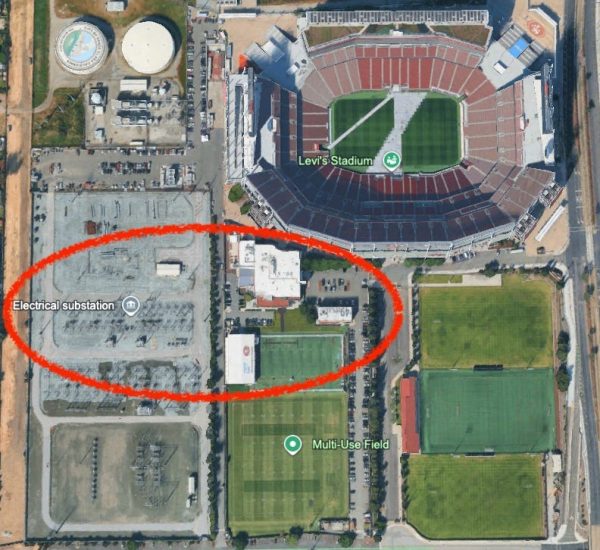
Cowan’s theory revolves around the electrical substation that is located next door to the 49ers practicing facility as well as the Levi’s stadium. According to Cowan’s theory, the electrical substation emits a low frequency EMF, which “can degrade collagen, weaken tendons, and cause soft-tissue damage,” as stated in his X post.
The mitochondria generates most of the chemical energy needed to fuel the cell’s biochemical reactions, and ultimately distributes energy throughout the body. The mitochondria also has its own EMF. In an interview, Cowan said that “what happens with [the] magnetic field [produced by the electrical substation] … [is] it gets laid over [the] endogenously produced electromagnetic field on your mitochondria, and it disturbs it, and you lose electrons, [which] leads to less water [and] less energy.” It is this alleged dehydration of the mitochondria that Cowan believes leads to injuries such as ruptured Achilles or hamstring tears. In simple terms, Cowan compared this idea to leaving a rubber band in the sun, which will cause it to become brittle, and easier to snap.
During a trip to San Francisco, Cowan did his own investigation of his hypothesis. With his gauss meter — a tool that measures the magnetic field — he got as close to the electrical substation as he could. Cowan admitted he “wasn’t very close,” and got a reading of 8.9 gauss. “8.9 in traditional standard. As far as institutional safety factors go, they would consider that to be very low.” He continues, “as far as I’m concerned, compared to your average environment exposure at a residential location … you’re gonna get around 0.5 to one.” However, Cowan added to his claim and said that “it’s not the strength of the field that matters, it’s the change between two different strength fields [that causes the damage].”
It is important to note that many of these claims lack a strong scientific basis. Cowan does not have a degree in biochemistry, and his article that he wrote on the matter is self-published, on his own website. David Sherden, a certified athletic trainer, retired Franklin sports med teacher, and lifelong 49ers fan, noticed that some of Cowan’s research “[is] not peer reviewed.” While Cowan has many sources to back his study, Sherden broke it down and said, “what he’s got is a hypothesis, that’s step one. Step two, — and he’s started to do this,” Sherden continues, “[is that] he needs to do more retrospective study, where you go back and examine data that you already have, and see if it correlates with your hypothesis. Step three is … do some controlled experiments. He doesn’t have the evidence he needs, but he’s got a hypothesis.”
Dr. Sahnzi Moyers, the AP Biology teacher at Franklin, also emphasized the need for controlled experiments. She said in order to do so, “they would have to have a lot of background on the EMF levels in the stadium [and] where they’re practicing, then they would have to look at that [specific] level of EMF and be able to reproduce it in a lab and [prove] that it is degrading collagen.” However, there are a few studies that look into the effects of EMF with the collagen in guinea pigs, but as of now “there is no firmly established evidence,” stated radiology professor Jerrold Bushberg for an article in Front Office Sports.
Cowan, however, also mentioned an addition to his theory. “I think the circadian rhythm disruption is actually the most important factor,” remarked Cowan. Many professional athletes are constantly changing time zones and playing late at night. Cowan claimed this can also affect collagen recovery. “I think the reason it didn’t get picked up as much is because it’s not specific to the 49ers, whereas the EMF is, but it’s a much more universal effect.” Though, as far as EMF weakening collagen goes, the debate is still ongoing. “Who knows? In 10, 12 years, this could all be proven [to be] correct, [or] it could all be proven false,” said Sherden.