


As the days grow colder and the sun begins to set shortly after the school day ends, so begins the highly anticipated start of the snowboarding and skiing season. For many, snow sports serve as the winter equivalent of summer’s adrenaline-filled activities — a way to enjoy and appreciate the harsher weather of the winter months. Here’s what to expect on the mountain this season.
It’s hard to predict the specific details that determine optimal conditions, but climate patterns can give us a clue. So far, this year is projected to be a weak La Niña — a climate pattern in the Pacific Ocean — bordering on neutral. This indicates an average to slightly below average snowpack — the snow accumulated throughout the season. Dallas Glass, deputy director and avalanche forecaster for the Northwest Avalanche Center (NWAC), explains what this means. “There are numerous global climate patterns that can influence local weather. El Niño and La Niña [make up] one such pattern. They indicate when the water surface temperature at the equator in the Pacific Ocean [is] above [El Niño] or below [La Niña] average.” He continues, “In the Pacific Northwest, there is a good correlation between moderate and strong La Niñas and greater than average snowfall during a winter.” While these climate patterns don’t necessarily predict the winter, they can help those forecasting for the upcoming season in determining whether colder and snowier weather is more or less likely.
To skiers, snowboarders, and those who enjoy being in the snow in general, Glass offers this advice: “Winter weather is dynamic and exciting. If you love playing in the snow, make sure to keep an eye on the weather. When you see colder temperatures, lighter winds, and some fresh snow … game on!”
His excitement is shared by Jo Taylor, a student at St. Mary’s Academy, who works as a junior instructor in the children’s learning centre at Mt. Hood Meadows, a popular ski resort. Taylor grew up skiing, thanks to her grandparents, who encouraged her to take lessons when she was young. This eventually led her to a love of the sport herself. She now also teaches kids of all ages and skill levels, expressing that, “It’s truly such a fun and rewarding job, and I love to watch the kids grow to love skiing as I did when I was their age.” Taylor continues, “I would say it’s probably about equal amounts of teaching versus picking kids up when they fall, talking them into trying a run they think they can’t, and hot chocolate and board game breaks.” Regarding mountain safety, Taylor comments, “Meadows keeps a constant watch on conditions and always has safety as their first concern.”
Like many outdoor activities, skiing and snowboarding offer opportunities to connect with people and nature. “[Skiing] is now one of my favorite ways to spend time and explore outside, as well as spend time with friends and family,” says Taylor. Glass adds, “Every day I go out I learn something new about the mountains, about the weather, and about the snow.” However, particularly with winter sports, safety is a significant factor to consider.
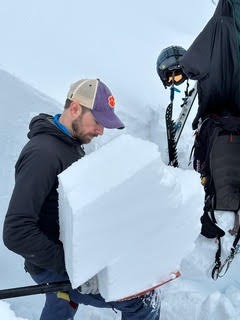
The NWAC office is co-located with the National Weather Service in Seattle. “During the winter, one forecaster works in the main office each day, monitoring the weather and producing daily mountain weather forecasts,” Glass explains. To do this, the forecasters observe many variables, such as “ridgeline winds, snow levels, temperatures [at] 5,000 feet, and precipitation for all 10 of our avalanche forecast zones.”
The main priority of these forecasters is keeping watch on the avalanche risk each day. “As avalanche forecasters, we are often more interested in how much precipitation will fall rather than how many inches of snow. This is because it’s the weight of the snow that frequently impacts avalanche concerns,” he details. “Additionally, several factors like elevation, temperature, and local terrain features have big impacts on how much snow is produced from a given amount of precipitation.”
Aside from safety, skiing and snowboarding can be inaccessible to many. As two of the most expensive sports to participate in, transportation can play a role in the cost. The Mt. Hood Express is a great transportation option for reaching the mountain. Portland commuters can transfer from the Gresham Transit Center to the Sandy Transit Center via the Sandy Area Metro (SAM) buses. A one-way ticket on the Mt. Hood Express costs $2, whereas a round-trip ticket includes unlimited SAM passes and costs $5.
Whether you’ve been participating in winter sports for years or are aiming to learn a new skill this winter, staying updated on weather conditions is crucial to the assurance of your safety and enjoyment. The Northwest Avalanche Center (nwac.us), Central Oregon Avalanche Center (coavalanche.org), and the National Oceanic and Atmospheric Administration (noaa.gov) — in addition to local weather forecasts — are all resources to monitor in order to stay safe this winter.