


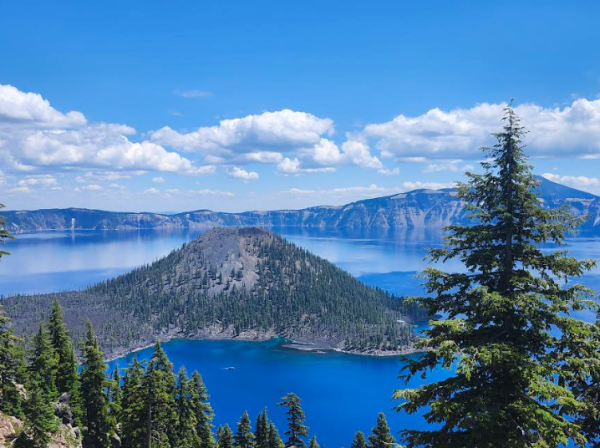
The Pacific Crest Trail (PCT) stretches from the border of Mexico to Canada in the Sierra Nevada and Cascades mountain range for 2,650 miles. Passing through the immense deserts in California, the lush green forests of Oregon, and across the mountains and valleys of Washington, the journey’s sights that will leave one breathless. It is a difficult trail for both the body and mind, demanding extensive planning and training. To prepare, hikers need the proper clothing, food, equipment, and mental preparation. Often, hikers decide to hike the trail to experience the tranquility of nature and find time away from the business of everyday life.
The Pacific Crest Trail Association (PCTA) ensures that the PCT is safe and well-maintained for hikers. Chris Rylee, the director of marketing and communications for the PCTA, explains that the association was created as part of the National Trail System Act of 1968, which required that trails be maintained through private and public partnership. The PCTA works to uphold this promise, employing volunteers to remove boulders, fallen trees, and other brush that blocks the trail. “It needs to be accessible, so that anyone who wants to get out there [can] have a really nice, beautiful wilderness experience [and] an isolated experience,” says Rylee. “There’s just something really special about looking at 2,650 miles of continuous trail and saying, ‘This needs to be connected.’”
For many, traversing the PCT is a way to have a deeper connection with their inner selves while immersed in nature. Becky Wandall, a seasonal tour guide who has blogged her travels on many trails, hiked the entire PCT in 2024. Her lifelong passion for the outdoors has led her to hiking and backpacking in many countries. Wandall was particularly attracted to the PCT because the trail connects two countries.
Wandall writes that her most unforgettable moments on the trail were: “The heat, hardness and sobbing on a ridgetop in Southern California, the light and jumping into the icy crystalline lakes of the Sierra Mountains, arriving into the cool moss-draped forests of Oregon, watching the Perseid Meteor Shower from Timberline Lodge, walking for days in fog around Mount Rainier, and then finally coming to the terminus at the Canadian border.”
The achievement of finishing the PCT motivated Wandall to hike more. “After the PCT, I know that I am stronger than I ever knew, and I know that I did not have to wait so many years to make my dreams come true,” she states.
On the trail, Wandall wanted to focus on immersing herself in the experience of the PCT and avoid distractions. “I think it is a shame to wear earbuds all day long and be completely immersed in an audiobook or music,” she says. “I would miss so much on the trail [if I wore earbuds]: birdsong, the wind through the trees, and the changing light.”
Alison “Blissful Hiker” Young is a professional speaker and award-winning podcast producer. Young has spent much of her life hiking and exploring new trails, and decided to take on the PCT during a difficult time in her life. To her, hiking the trail was a healing process, an opportunity to recover and gain perspective through nature. “I learned to trust myself and to trust life,” Young says. She received the trail name “Blissful Hiker” at the start of the trail. “I was so sad and scared for the future, but the mountains were extraordinarily beautiful. I simply couldn’t stop smiling,” she explains. “Another hiker said I was so blissful, I’d be smiling my way to Mexico.”
Hiking for long hours over many days is an exercise in strength and endurance. The PCT tests an individual’s ability to overlook challenges that may arise on the trail and to look on the bright side. Young shares, “There were hard days and struggles, but stepping forward and seeking bliss in all things can open us to the daily miracles that life offers.”
Some hikers on the PCT have the goal to power their way through the trail and test their endurance. Every hiker has their own goals, but Young believes many hikers go on the trail simply to experience the awe of nature. She says hikers “want to discover what will happen to their mind, body, and spirit in a walk that becomes a kind of lifestyle.”
The PTCA website offers helpful information about what equipment to bring on the trail and which places to visit. There are many ways people can experience the trail, such as thru-hiking, which entails getting a permit to hike long-distance; day hikes; overnight hikes; and backpacking.
“Hiking the PCT was one of the best things I have ever done,” reflects Wandall. Whether you are planning a two-hour hike on a portion of the PCT or a six-month journey, preparation is crucial. For a longer hike, Wandall cautions, “Don’t wing it. You are putting rescue teams at risk. Cold, wet, unplanned camping trips are not that fun for anyone.” With enough preparation, hiking the entire PCT is possible. However, if that is too much time or the concept of hiking 2,650 miles makes you nervous, you can always choose a shorter hike. Just pick a spot along the PCT that you want to explore, bring proper supplies, and immerse yourself in the immense and beautiful wilderness.