


Supreme Court Justice Ketanji Brown Jackson is a lot of things. She’s an accomplished public servant. She’s the first African American woman on the bench of the United States Supreme Court. She’s a Harvard graduate with honors. She’s been on Broadway. And she’s also really funny.
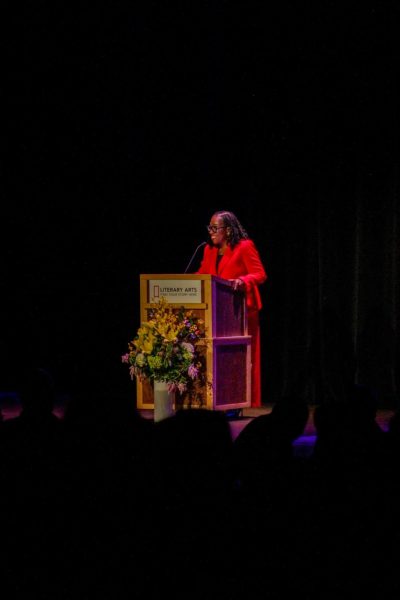
In front of a sold out crowd at the Arlene Schnitzer Concert Hall on March 12, Jackson sat down with John Newbery Medal-winning author Renée Watson for an animated and humorous book talk on her 2024 memoir, “Lovely One.”
The title is an English translation of Jackson’s first and middle name, Ketanji Onyika, which has unknown African ancestry.
The memoir spans from her early childhood all the way up to her Supreme Court nomination and swearing-in ceremony in 2022.
With the Court holding a 6-3 conservative supermajority, Jackson and her liberal colleagues on the bench have been on defense as the Court steamrolls forward — ruling conservative on key issues, like using race as a factor in targeting immigration enforcement and giving the president heightened immunity when in office.
Most recently, Jackson was the sole dissenter in Chiles v. Salazar, which struck down a Colorado Law banning conversion therapy. Reading her blistering dissent from the bench, she walked the Court through her argument.
However, in front of her Portland audience, Jackson refrained from discussing her current work in the Court, only once hinting at the political reality. “It’s a very challenging time,” she said. “The work is difficult. I’m doing my best.” Beyond that, the talk stayed light-hearted and distant from the legal battles fought inside the Supreme Court, much to my initial disappointment.
How often does one get to hear a Supreme Court Justice speak? I — admittedly naive in my expectations — itched in my seat for a legal lecture on the consequential cases in front of the Court, or a thrilling insight into the process of authoring her famously candid opinions. But we didn’t get any of that. Jackson’s hour at the Schnitz ended up being worth so much more. Here’s why:
“Lovely One” Is Not a Legal History
Obviously. If the book kept to the principles of precedent and procedure, it might not have topped the New York Times bestseller list, or have been selected by the Multnomah County Library to be the “Everybody Reads” book of 2025. In a word, the book and talk were accessible, in more ways than one.
“Lovely One” has been widely read by Portland. Multnomah County Library has distributed 8,000 copies of “Lovely One” and its e-book and downloadable audio have been checked out more than 2,200 times, according to a statement from Literary Arts given to The Franklin Post.
Additionally, Jackson visited Jefferson and Parkrose high schools, an exceptionally rare choice for a sitting Supreme Court Justice. They are not politicians — Justices have no voters to please for reelection — making appearances is rare and often strictly in legal or academic spaces.
Jackson’s opinions speak for themselves. “I’m not afraid to use my voice,” she said in a public statement in 2025. “If I disagree, I’m going to say so.” Her dissents have been especially sharp and unapologetic. “Lovely One” and her visit to Portland have allowed her to pull back the curtain and show the public who is behind the strong writing at the Supreme Court. At a time when the bench as a whole is approaching historic lows in approval, her book and event is important in familiarizing the public with the unelected Justices on the highest court in the nation.
Portland Needed a Laugh
Ever personable, Watson and Jackson walked through some of the lighthearted stories in “Lovely One,” which encompasses more than the Justice’s path to the Supreme Court.
A story which landed especially well with the crowd was Jackson’s elaborate first date with her husband while they were undergraduate students at Harvard.
She remembers her future husband taking her to his house on Cape Cod. “I wasn’t sure it was a date!” she said, through a chuckle. They went to his parents’ house on the Cape where he cooked her dinner, and then they ventured into the den for a movie, all while the future Justice was getting increasingly frustrated with him for not making a move.
As he yawned to try and smoothly put his arm around her in the den — the cliché move not lost on the crowd — she jumped up and confronted him about being indifferent during the date, ending in an immediate declaration of love from her now-husband Patrick Jackson. He always said, even decades before she made it on the Court, that his future wife would be a Supreme Court Justice one day.
“I love your love story,” said Watson, as the laughter and cheers died down. “It’s a rom-com!” Her heartwarming first date with her husband is just one of the ways that “Lovely One” is a story of success which is in no way limited to just Jackson’s meteoric rise to the bench. It’s about success in love, as a parent, and with family and friends.
For a liberal stronghold like Portland, it’s a rare story of hope. As a reader and listener, I couldn’t help but root for Jackson as she honestly laid out how she overcame everything from being homesick in college to picking the right school for one of her daughters, who is autistic.
In a fractured Democratic party, which does not control either chamber in Congress, the presidency, and faces a 6-3 conservative supermajority in the Supreme Court, Jackson’s story as a public servant, judge, mother, daughter, and so much more, is uniquely easy to get behind.
Impact
Jackson’s visit to Portland was brief, yet powerful, reminding the hundreds at the Schnitz and the thousands more who read “Lovely One” that success, familial and professional, is just around the corner.
Thank you, Justice Jackson, for your visit.