

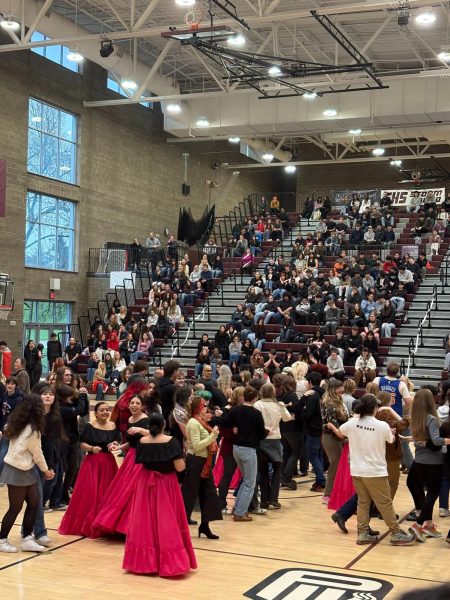
“We are here today to celebrate identity and culture, and come together as a community in tough times,” said Franklin Principal Dr. Zulema Naegele at the beginning of the annual Franklin Black, Indigenous, and people of color (BIPOC) Assembly on March 12. The assembly aims to bring people together and honor the multitude of cultures and ethnicities within the Franklin community.
The assembly began with Baile Folklórico, a traditional Mexican dance that reflects regional culture, fashion, and history. This dance was a preview of a Franklin Arts Alive performance, scheduled for later this spring. Performances such as those performed by Franklin’s Indigenous student affinity group, Tribal Nest, where dancers performed Jingle and Grass dances — healing traditions characterized by rhythmic sounds — were also part of the assembly performance. Some performances also encouraged audience participation, such as a collective owl partner dance rooted in Indigenous culture, where volunteers were called to the floor by members of the Associated Student Body (ASB) to dance with one another, which highlighted the different cultures within the Franklin community.
In the 1990s, former Franklin social studies teacher Geoff Brooks founded the assembly tradition. However, during this time, it was the “Martin Luther King Day Assembly.” After a few years, it was renamed as the ‘Multicultural Assembly,’ developed by former Franklin counselor Hoang Tran. He established the assembly’s intention to reflect and honor diversity within the Franklin community. After Tran’s passing in 2019, the assembly continued to honor his life and time at Franklin and was supported by SUN and ASB, in addition to student affinity groups. Staff turnover in both SUN and ASB has left much responsibility for continuity of the assembly in the hands of returning students.
In 2024, after some students objected to the lack of LGBTQIA+ culture represented in the assembly, the name was changed to the “BIPOC Assembly” in order to preserve its commitment to representing racial and ethnic diversity. In recent years, Franklin’s Pasifika Unity Association (PUA) has worked closely with administrators and staff to make the BIPOC assembly as meaningful as possible. The club was offered resources from administrators to create the audio for performances.
However, after meeting with other affinity groups, members of the club came to realize that they feel this assembly is one of the few times during each school year when Franklin truly honors identity, according to an affinity club president, who requested anonymity for fear of retaliation. The president explained how affinity groups work closely with one another to educate students during heritage and history months, claiming limited support from staff and administration. They said that although affinity groups are proud to share their cultures and experiences, it can feel as though their efforts are treated as performances rather than opportunities for learning. “There is a difference between celebrating identity and expecting students to consistently educate or ‘entertain’ others without meaningful engagement or appreciation in return,” they said.
During a recent assembly, the PUA prepared to put on a musubi-eating contest, only to be removed from the assembly due to a lack of time, and notified of their removal after the assembly had started.
As a result of feeling that their time, efforts, and culture were not treated with respect, the club made the decision not to perform at the BIPOC assembly this year. In solidarity, several other affinity groups joined them, including the Latino Club, the Muslim Student Union, and Portland Dance K-Pop (PDK). Another anonymous affinity club representative, whose members supported the PUA in protest, said, “We all felt really misrepresented and not supported enough, like we had to work harder than others to have an equal amount of space and time within our school community.” They added, “This really showed how when one community is disrespected, it impacts us all as a whole and spreads.” They expressed that this is an underlying issue that they have seen overlooked for quite some time, not just this academic year.
Franklin administrators, as well as Olivia Marovich, Franklin’s activities director who runs ASB, were not able to provide comment before publication.
The assembly typically ends with a prominent flag walk, where all the affinity groups gather together and make their way around the gym, celebrating their cultures and identities with flags. However, only a small number of clubs took part this year.
Since the assembly, Franklin held a club fair that multiple affinity groups — including some that chose not to perform at the assembly — participated in. Despite their absence at the BIPOC assembly this March, affinity groups at Franklin are still working to support the Franklin community.