

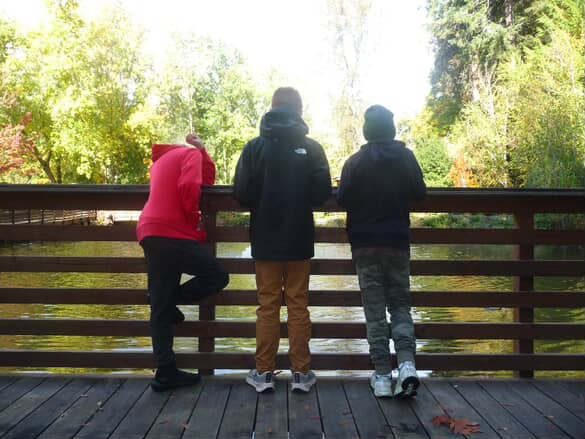
Since 1966, Multnomah Education Service District has hosted approximately 10,000 sixth-grade students annually through Outdoor School (ODS).
ODS was among many camping education programs Oregon adopted when they were popularized throughout the early 1900s. In 1957, Dr. Irene Hollenbeck of Southern Oregon College led Oregon’s first formal exploration of ODS as we know it today. In the unique and unreplicable experience of outdoor education, students have the opportunity to gain insights beyond typical classroom teaching.
Students often leave ODS with memories that last a lifetime. Eleanor, a sixth grader at Mt. Tabor Middle School (MTMS) who attended ODS earlier this year, says the experience helped her form new friendships. “I made all these new friends, and I really bonded with people,” Eleanor explains. ”When you’re not seeing someone in a school environment where you’re judged on how well you do, it [becomes] personality-based.”
Gina Gray, a Science teacher at MTMS who accompanies sixth grade classes to ODS, says many students are “very nervous about going and being in a cabin with a lot of people they don’t know.” She continues, saying that many students make robust connections and often leave them crying when it’s time to go. Taylor Wisner, a senior at Roosevelt High School and a passionate student leader, says, “Outdoor School was easily the highlight of my middle school years,” Wisner says. “I started my week off crying. I was scared to leave home, [but] by the end I was crying because I didn’t want to go.” She reminisces, “I remember the feeling of being so welcomed and accepted into a community made me so happy.” Wisner explains her return to the ODS community, saying, “I wanted to become a student leader so I could help other kids experience what I did, ” she says. “After my first week, I knew I had found my passion because I had never felt so happy and proud of myself.”
Everett, another sixth grader who attends MTMS, reassures nervous fifth graders attending ODS next year, saying, “[The staff] are really caring, they will contact home if it gets serious, and they’ll take care of you when there … they treat you like their own.” However, this environment doesn’t just provide comfort for students; it also acts as a rich learning space where students succeed. As Wisner says, “The more [cared for] students feel, the more eager they are to learn.”
Similarly, Murphey Haller, a specific needs volunteer at Camp Collins ODS, who attended ODS in sixth grade and served as a student leader for 10 weeks during high school, says one of the biggest reasons he comes back is to help children thrive by accommodating their learning styles and showing them genuine empathy and care.
Students and staff say that ODS provides a safe environment for personal growth and social connection. Gray says she has noticed students who struggle in a traditional classroom environment often excel in outdoor education.“It made me want to know more about plants and rocks and all that kind of stuff, [and] I’m more interested in science this year,” Everett says.
According to Friends of Outdoor School– the nonprofit that supports ODS, ODS faced a $12 million budget cut in June of 2025. This has had tremendous consequences for the program, such as shortening week lengths to three days and site closures. Gray feels the new length doesn’t allow students to become integrated and believes everyone deserves the full experience. “That’s one of the things that makes it so cool. So many different schools and types of students come together,” she says, adding, “I think everyone should have the opportunity to experience something different than a normal school day, but still learning.” In response to proposed funding cuts, she feels that sixth graders will miss out on many enjoyable opportunities.
Those involved often feel a long-term impact from the community building that occurs at ODS. Haller says he made many deep-rooted connections in his week away, people he still knows today. “[It] truly changed me as a person.” Many sixth graders who attended plan to return. Interviewees say the uninterrupted time together fosters friendships and develops confidence in ways that differ from a traditional classroom setting.