

In a Jan. 24 all-staff email, Franklin Principal Dr. Zulema Naegele informed Franklin staff of the district-wide changes going into effect at the start of the 2026-27 school year. Specifically, valedictorian selection is now to be based off of weighted GPA, honors coursework designation will no longer be offered in any capacity, and Study Hall offerings will be collapsed. As of publication, these changes have yet to be officially announced to families and students. Naegele explains that, as the changes are district-wide, she expects the district to communicate them to families in the spring.
Dr. Filip Hristić, Portland Public Schools (PPS) senior director of academics for grades 6-12, explains that making these changes is largely in an effort to “catch up” with academic trends across the state and country, and encourage students to engage in rigorous coursework that is standardized across the district. He emphasizes that the perceptions of college admissions officers were considered in all three changes, and that each of these decisions comes after deliberation at the district level. Hristić specifically mentions PPS’s Policies and Practices Committee — made up of counselors, administrators, and “most often vice principals from all of our high schools including our alternative programs” — as being part of the discussion surrounding valedictorian systems. Naegele confirms that Franklin administrators were present at some of these discussions.
Hristić explains that these changes, particularly the removal of Study Hall, were not motivated by budget, yet concerns remain prevalent at the school level in the face of PPS’s $50 million budget deficit. At the end of the 2024-25 school year, the Franklin Post reported on the impacts of a $41 million budget reduction in the current academic year, which threatened 228 positions district-wide as well as classes with enrollment under 15 students. Franklin’s district liaison, junior Eve Thompson, is concerned about the impact on students of cuts to academic offerings and supports. “We’re going to see a lot of [budget cuts] next year. I’m like 95% sure students will not get told what is going on until when we’re walking through the school,” she says. Additionally, Thompson wonders if sufficient student input was sought before these changes were decided, saying, “The District Student Council was not asked about [this].”
Valedictorian
Across the district, valedictorian designation will now be awarded to students with the highest weighted GPA. Previously, all graduating seniors with a 4.0 unweighted GPA, meaning they received an A in every class taken throughout the first seven semesters of high school, would be awarded valedictorian. Hristić says there were concerns about what this system encouraged. “We had been hearing from counselors [on the Policies and Practices Committee] … that, in some cases, students were hyperfocused on trying to maintain a 4.0 GPA in order to receive the valedictorian recognition, but in doing so may have not chosen to take more rigorous courses that would have compromised their perfect GPA.”
Hristić acknowledges that, “The other piece was also, I think some people expressed discomfort about knowing, in some cases, our valedictorians were 4.0 students who never took an upper-level, challenging class, and kids who took multiple AP classes.” This system produced a high number of valedictorians each year; Portia Hall Rockne, Franklin government teacher and announcer for the school’s Senior Recognition Assembly, reports around 60 valedictorians last year, 61 in 2024, 58 in 2023, and 55 in 2022.
Starting with the graduating class of 2027, valedictorian will be awarded based on weighted GPA, a 5.0 scale bolstered by Advanced Placement (AP) or International Baccalaureate (IB) classes. The valedictorian pool will be significantly smaller, though it can still be awarded to multiple students. Both the Jan. 24 memo and Hristić detail the expected benefit of this shift as encouraging students to take more rigorous classes by deemphasizing the award of valedictorian.
In conjunction with this change, class rank will be removed from student transcripts. The Jan. 24 email clarifies that, if a scholarship or college application requires a student’s class rank, their high school will be able to provide it.
The policy recommendation was passed from the Policies and Practices Committee to district officials and high school principals. “We’re really going to try to incentivize students, by including weighted GPA, to take challenging, rigorous courses,” Hristić states. “Your GPA, ultimately, doesn’t matter as much as the breadth, the depth of the courses that you take.”
Honors Designation
Honors designation, an add-on for coursework available at some PPS high schools, will be discontinued. Previously offered in certain English, math, and science classes, the option of honors was an interdepartmental decision and varied by school. A memo written by Hristić was sent to high school principals on Nov. 17, 2025, announcing the discontinuation of honors offerings, which were described as inconsistent, informal, and responsible for creating “inequities and transcript inconsistencies.”
Hristić expresses that the lack of standardization for honors was a point of concern for the district: “If I looked at a transcript and saw an AP or Pre-AP class, I could say what that meant. If I saw honors, I couldn’t,” he comments. He explains that, if PPS chose to adopt specific honors courses, they would have to go through a process of adding them to an official district-wide course list.
Franklin had explored how to remedy inconsistencies in honors programming at the end of the 2024-2025 school year under former instructional coach Yoshio Drescher. Drescher, now a vice principal at Ida B. Wells High School, states that “the impetus actually came from the district.” Drescher compiled an honors coursework tracker and contract for teachers.
In October of 2025, Franklin’s newly arrived instructional coach, Leslie Brown, held a conversation with the English department regarding the update to honors, working off notes from her predecessor. Though only the English department was addressed that day, the effort to update and standardize honors at Franklin applied to all departments offering honors, and Brown believes it was communicated to them shortly thereafter.
Naegele commented that Franklin had continued to discuss updating honors throughout the fall, as the district had not yet decided if offerings would be discontinued. “Regardless of what the district decided to do, we wanted to be aligned with Franklin,” she says, referencing Franklin’s previous honors policy. As the future of honors designation remained unclear, Franklin staff were not updated and some departments, including the English department, continued work to revamp their honors curriculum.
Thompson believes honors designation can be an important way for students to challenge themselves in introductory classes, particularly those required for graduation, such as freshman year Physics 1-2 or English 1-2. “I think it, for lack of a better word, really sucks,” she comments. David Stroup, a Franklin science teacher who previously offered honors in his chemistry and AP Physics classes, says he is “disappointed in the change,” explaining that, “It’s been an important way to let students who want to go beyond the basic expectations of the class … find their own way to work harder and investigate other subjects.”
Study Hall
Starting next year, Study Hall will no longer be an option for PPS high school students. Kari Harrison, who moved from Alliance High School to her current position over a year ago, currently serves as Franklin’s Study Hall monitor.
“For most of the students that come here, I think it’s going to be a big blow,” comments Harrison about the loss of the offering. “When I came here, I didn’t believe in Study Hall. But … I have seen AP students use Study Hall, I have seen students with special needs or foreign languages and all sorts of different situations [use it]. … By and large 99% of you guys use it for what it’s for.”
Thompson believes students will feel the impact of this removal, saying, “I think that it will be greatly detrimental to students’ mental health, who relied on Study Hall because they had jobs or extracurriculars.” Another impact, she posits, is that “there will be more kids who would end up with late arrivals and early dismissals.” The removal of Study Hall was not communicated officially to students before Franklin’s forecasting period began.
While the official district policy change stipulates that a traditional Study Hall, supervised by a non-licensed professional, can no longer exist, it allows for academic support classes taught by a licensed teacher. Harrison says she was told “there is not any budget for that.” Naegele says that at Franklin, “We don’t have a plan to offer that class,” noting that the school is still in the process of determining next year’s full course list. She says that many factors are contributing to the decision of whether to offer academic support classes, including budget.
“This year there were only two or three high schools that were still offering that traditional, old school Study Hall. Most other schools — basically six or seven — had already transitioned to offering academic support or academic skills classes taught by licensed folks,” Hristić explains, noting his uncertainty about the exact number.
Harrison says she was informed her job was cut a few weeks before students were. Whether she will have a position in PPS next year, “It’s hard to say, I will be unassigned, probably, meaning they may or may not have a job for me depending on enrollment next year,” she says. Following her notification, she says that other PPS Study Hall advisors in the Portland Federation of School Professionals union “had not been informed their jobs were being cancelled.”
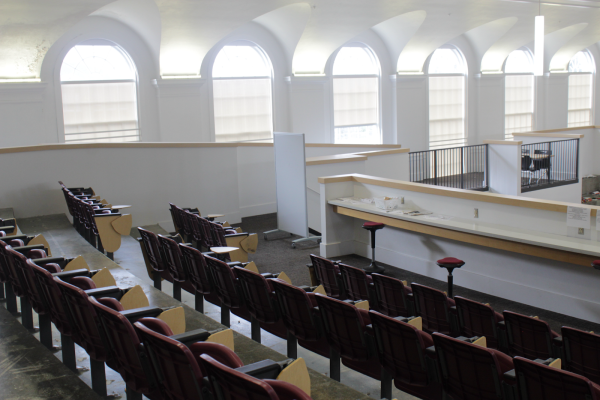
What will occupy the current Study Hall space — the second floor of the Franklin library — next year remains unknown.
“Overall, it’s just really important that we are as aligned as possible with other high schools,” says Naegele, “because I want to make sure that our Franklin students have the same opportunities to take a class [here as they would] at any other school.”