

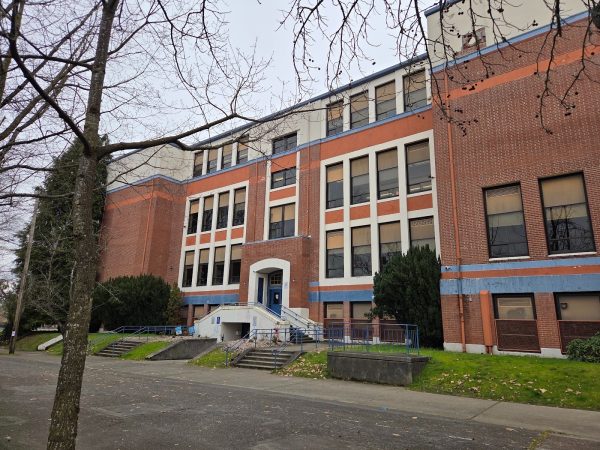
On Jan. 13, the Portland Public Schools (PPS) board voted to end the dual assignment program at Jefferson High School, changing it from a magnet school to a conventional neighborhood school. Beginning in fall 2027, students from Beach, Chief Joseph, Faubion, Vernon, Boise-Eliot/Humboldt, Dr. Martin Luther King Jr., Sabin, and Woodlawn Elementary Schools will now eventually feed into Jefferson High School. Irvington Middle School students will go to Grant High School, and Peninsula Elementary School and the Spanish Immersion program at Beach will feed to Roosevelt.
PPS officials hope these changes to the feeding patterns will increase enrollment at Jefferson following years of dwindling numbers. In 2011, while making plans for the modernization of PPS schools, the school board gave dual assignment status to Jefferson. This allowed families who lived in certain neighborhoods in North and Northeast Portland to choose between schools, offering them the option between Jefferson’s Middle College program or a more conventional experience at Roosevelt, McDaniel, or Grant High Schools. Many families opted for these other schools, leaving Jefferson with dwindling numbers.
In the 2025-26 school year, there were 391 students enrolled at Jefferson, compared to over 2,100 students at Grant, 1,400 at Roosevelt, and 1,600 at McDaniel. Although enrollment has been dropping across the district in the last few years — a 13% decline since 2019, as well as throughout the state — Jefferson has faced much steeper declines than most other schools.
“There is a false image of our school out there,” says Brian Nguyen, a senior and the student body president at Jefferson. “[Some] students and families who do not go to [Jefferson] believe that our school is ‘ghetto’ and ‘not cohesive.’” Interviews with staff and students, as well as ongoing discourse surrounding Jefferson’s enrollment, have indicated that declining enrollment stems from layered and multifaceted causes — false assumptions, racial prejudice, a history of redlining and segregation, as well as a desire by parents to send their students to more modernized and better resourced schools have all perpetuated a cycle of declining enrollment.
“This [low enrollment rate] means we can’t offer the same kind of classes, programming, and opportunities as every other comprehensive high school in Portland,” says Rebecca Norman, a counselor at Jefferson. Rather than the extra English and science classes common at other high schools, Jefferson currently offers a Middle College program. The program is a partnership with Portland Community College to give high school students experience with college level coursework. Jefferson offers a large number of dual credit courses, and expects students to complete 12 college credits before graduating. The Middle College program offers a valuable opportunity to Jefferson students, especially those who grew up with limited resources, explains PPS Assistant Superintendent of School Planning and Modernization and previous Jefferson principal Margaret Calvert. The program will likely face changes relating to Jefferson’s conversion to a non-magnet school, but according to Calvert, “the commitment has been to maintain partnerships with higher education.”
Jefferson does have other strong extracurricular programs, such as the Jefferson Dancers, who have performed internationally. “Even though our program has a notable reputation across the country, we’ve been having fewer dancers and classes due to our small numbers,” says Nguyen, who serves as captain of the Jefferson Dancers II. This is the case for many of the programs and classes at Jefferson. Norman laments that “we no longer offer choir this year because we don’t have the number of students to support it.” She hopes that higher enrollment from these boundary changes will “increase our budget and lead to more stable programs and opportunities.”
Eve Thompson, Franklin’s district student council liaison, believes that, though this issue may not directly impact Franklin students, it is still important. She stresses that “PPS [is] a community,” and many Franklin students have friends at Grant, McDaniel, Roosevelt, and Jefferson, or may know families who live within the impacted districts. “Families are upset [about the district change], and we need to come together in a time of need,” says Thompson, who believes that the rivalries and racial prejudice driving people away from Jefferson are a source of division within our community. Jefferson students and staff and the PPS administration both hope that the redistricting will help to strengthen community ties.