

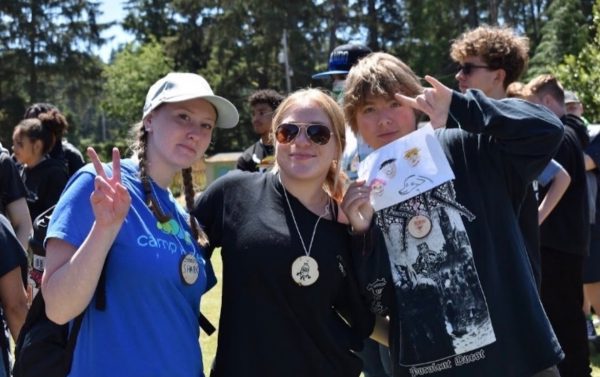
“Being at camp is such a hard feeling to describe. It’s the closest to euphoria I’ve ever felt,” says Monroe Colbath, a student at Churchill High School in Eugene. Colbath is describing Camp Kesem, a summer camp that brings together children across the country who are facing a parent’s cancer.
Often referred to as Kesem for short, this camp creates a space for these children to experience the typical joys of childhood as they navigate grief and the challenges of having a parent with cancer.
Colbath, a current camper who has attended Kesem for four years, describes how the environment feels like a family, saying, “Kesem friendships are special because we all have the same experience. It manifests in different ways for everyone, but there’s a certain pain we all know.” He adds that the connections he has made at Kesem are “life long friendships.”
A non-profit organization, Kesem serves youth around the country through various services. “Kesem operates as a national organization with a strong local presence through college-based chapters across the country,” explains Brooke Argue-Brackett, the Kesem regional program coordinator for Northern California and Oregon. Currently, 115 colleges host chapters that provide year-round opportunities at no cost to families.
While the summer camp is Kesem’s flagship program, year-round support is offered through the college campus chapters. This includes friends and family days, peer support groups, and various other initiatives. The national team designs these programs, while the individual chapters are in charge of executing them and establishing relationships with families.
Argue-Brackett explains that as a regional coordinator, much of her role focuses on the overnight summer camp. Her involvement began on a personal level. “My father passed away from cancer when I was 13 years old. I sadly did not have Kesem in my life then, but once I heard about the mission, I was hooked to committing my time and efforts to furthering our reach and mission across the United States,” she says.
Though only a week long, the camp quickly fosters community, as described by camper Chloe Stevens. “Being at camp is a huge escape from reality and what might be happening at home,” Stevens says, describing the atmosphere as “incredibly supportive and welcoming.” While the ages of campers range from 6 to 18 years old, Stevens explains that “Everyone is there for the same reason, so there’s a sense of understanding and comfort that you don’t usually get in everyday life.”
Keren McCord, manager of the Knight Cancer Institute’s Patient and Family Services Department at Oregon Health and Science University and an oncology social worker, began volunteering at Kesem eight years ago. She found Kesem while looking for a resource for cancer patients with children. “Getting a cancer diagnosis is overwhelming and scary for anyone, but I found there is a unique set of concerns for patients who had young children. Being able to recommend camp felt important,” she describes. McCord feels that having a recommendation like Kesem for patients is incredibly important for families navigating a diagnosis.
Volunteers like McCord help Kesem function. “The counselors play a huge role in shaping the experience. I truly feel like every counselor I’ve had at Kesem, talks to me like I am their peer. I always feel included, and genuinely cared about,” shares Stevens. She adds that one of her counselors was the first person she met on the way to her first year at camp, which increased her excitement and immediately calmed her nerves. The relationship between counselors and campers is essential to the supportive environment at Kesem. McCord says,“[Their] training is incredible, and encourages professional and compassionate care for kids who are trying to integrate what it means to have a parent with cancer.” Colbath agrees, having had very meaningful experiences with previous counselors, describing the relationship as “symbiotic … we build real family–like bonds with them.”
Ultimately Kesem hopes to provide opportunities for children to experience the fun of childhood during a difficult time in their lives. Every day at Kesem is packed with different activities, including arts and crafts, sports, ziplining, dance parties, and water activities. But some special traditions always return, like the nightly cabin chat where campers within their cabins can share whatever they’d like to with each other. Colbath describes it as a way to “decompress your day,” while Stevens says, “We can have deeper conversations about why we’re at Kesem and share more personal experiences.”
Another meaningful tradition is the Empowerment ceremony, which occurs at camp once and is meant to establish and recognize what brought the group together. Empowerment allows campers to share personal stories, and what brought them to Kesem. McCord explains that hearing the testimonies of the campers highlights their resilience, saying, “Empowerment is an opportunity to reflect that resilience back to the campers, and also affirm that all of their feelings are accepted at camp.” Argue-Brackett adds, “Campers are given space to share their stories, build confidence, and form deep, lasting connections with peers who are walking similar paths.” These traditions provide designated space for the campers to process and discuss their experiences, while maintaining an environment filled with moments of joy and adventure.
Argue-Brackett summarizes: “Kesem’s impact goes far beyond any single program. For many campers, it becomes a second home; a place where they feel understood, accepted, and supported by people who genuinely care about them.”