


“Solarpunk has so many definitions, but I see it as primarily a creative genre by which we imagine a world which is more equitable, sustainable, and balanced than our own,” says Reve, founder and organizer of PDX Solarpunx. PDX Solarpunx hosts a variety of solarpunk-oriented events and shares resources for spreading native plants in the Portland metro area.
Through sharing resources, cultivating native plants, and taking political action; solarpunks hope to reverse climate change and work toward a more equitable world where both nature and humanity thrive.
On their Instagram, @solarpunxpdx, PDX Solarpunx describes the group as “Your friendly, rag tag collective of neighborhood guerilla gardeners!” Guerilla gardening is the practice of cultivating plants in neglected places without explicit permission — such as unused municipal lots or abandoned buildings. Mat Merritt, a member of PDX Solarpunx who is pursuing a degree in environmental landscape management technology, says, “Guerilla gardening exists to subvert the red tape and not ask permission to plant and heal soil [in] underutilized spaces … These plants support biodiversity, soil health, and serve as climate mitigation strategies.”
Guerilla gardening is one of many practices and beliefs that make up the solarpunk movement. Reve defines solarpunk as, “An aesthetic and ideological movement which imagines a world post-climate catastrophe, where humanity lives in balance with the earth.” Through practices like guerilla gardening, mutual aid, and community workshops, solarpunks aim to move society toward that future.
The genre of solarpunk emerged in 2008 from the blog Republic of the Bees. It grew out of the literary genre of steampunk, which imagines a world where steam-based Victorian technologies — for example, complex clockwork-based systems — remained mainstream and were not replaced by the development of petroleum-based technology. In a world where oil-based machinery is not sustainable in the long term, solarpunk emphasizes forms of green energy such as solar and wind power, and promotes an environmentalist lifestyle. Republic of the Bees writes, “Solarpunk ideas, and solarpunk technologies, need not remain imaginary, and I indulge a hope of someday living in a solarpunk world.”
Throughout the 2010s, solarpunk evolved into a more complex and politically charged movement, particularly on blogging platform Tumblr, where solarpunk art and ideas remain popular. In his 2014 article “Solarpunk: Notes Toward A Manifesto,” Adam Flynn writes, “There’s something lovely in the way [solarpunk] reacts against the mainstream visions of overly smooth, clean, white modernist iPod futures. Solarpunk is a future with a human face and dirt behind its ears.” The aesthetics of solarpunk reject separation of nature and humanity, instead advocating for a shift towards an interconnected, environmentalist future.
“I would say [PDX Solarpunx’s] core ideology as a group is a curiosity and kinship with living things, and a desire to share and grow that passion to benefit all human and non-human communities,” Reve adds.
Part of working towards this idealistic world is incorporating solarpunk practices in one’s own life and community. Activities like DIY projects, guerilla gardening, and attending community events are common in solarpunk circles — all of them small steps toward fighting climate change.
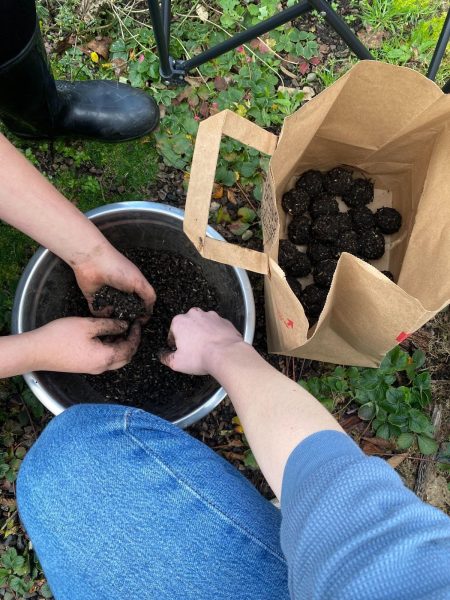
One of the most common and accessible forms of guerilla gardening is seed bombing. Seed bombs are small balls made of soil, clay, and seeds that are dried out and thrown onto land in hopes that the seeds will germinate. Reve describes them as a “deceptively simple work of plant technology,” adding, “It’s really important that you research what native seeds might be best for the job, and if you’re just getting started, I would strongly caution against using non-native seeds.” Introducing non-native plant species can disrupt local ecosystems and cause more harm than good.
The practice of guerilla gardening is inherently risky in terms of legality, as it can incur charges such as trespassing and vandalism. Like other punk movements, solarpunk embraces anti-establishment ideas, rooted in the belief that existing systems are often oppressive and unsustainable in the long term.
One method of subverting these systems is mutual aid, a practice that challenges the traditional idea of charity, where those with more power or privilege determine the amount of resources offered to those in need. Instead, mutual aid operates on the idea that everyone deserves access to resources and assistance, without any conditions or judgement. “Mutual aid is a cornerstone of what we do, and, in my opinion, any ideology worth your time,” says Reve.
Mutual aid is present in everyday interactions, even if it goes unnoticed. Reve describes the aftermath of a mild car crash: one person administers first aid, another calls 911, and someone else offers comfort. “No one is being compelled to help this person, and no tally of the resources expended to assist them is likely being kept,” she explains. “This is a theory of aid not based on transaction, but a commitment to each other’s well being and intrinsic worth.” She notes that this principle extends beyond individual interactions to “feeding your neighbors, supporting a global political movement, or even asking your community for support during a moment of hardship.”
That sense of community is central to groups like PDX Solarpunx. The group hosts gatherings like seed bomb parties, where attendees prepare seed bombs, collect plant clippings, and discuss politics and environmental issues. These gatherings foster a sense of community that members like Meritt cherish. “It’s so fun to be involved with like minded people at [PDX] Solarpunx,” he says. “Yes, we’re supporting each other, working on projects, and quizzing each other on native plant knowledge, but mostly it feels like hanging out with cool people,”
What sets solarpunk apart from many climate solutions is its emphasis on using and repurposing existing technology. Reve disagrees with the idea that entirely new or futuristic technologies are required to combat climate change. “While it’s true [that] certain technologies like wind and solar power have come a long way in efficiency and affordability, it’s an argument that has kicked the responsibility, and true solutions, to climate change down the road for decades,” she says. “Using existing, proven plant technologies, many groups and cultures have reclaimed their place in the fight against climate catastrophe and resisted the beckoning of technocrats who sicken the world while selling us the antidote.”
From a solarpunk perspective, the answer is not to create new tools, but learn how to repurpose and harness the tools of nature we already have. While the solarpunk movement is still relatively new in Portland and beyond, it has already built a strong community presence and made fighting climate change more accessible to Portlanders. From larger sustainability projects to smaller actions like exchanging knowledge or tossing seed bombs, the solarpunk movement is working toward the promise of a better world.