


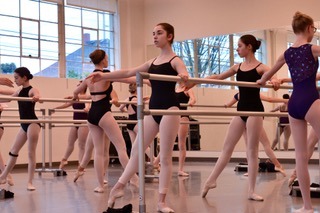
Ballet has been a well respected art-form for many centuries. Through its graceful qualities and advanced technique, the practice has been given a prestigious reputation. However, for years, the media has exposed its historically negative characteristics, the most prominent being body standard issues. In recent years, this has caused the ballet world to be viewed as a toxic environment, and not as a place for the developing brain of a child to be exposed to. Compared to such negative stereotypes, my experience in ballet has been extremely positive. Ballet has been a constant in my life, and despite these stereotypes, the ballet community is far more positive than some perceive it to be.
Ballet is a very rigorous and physical form of dance that takes years of practice to master. I started dancing at Oregon Ballet Theater when I was 4 years old. In the time that I have spent perfecting my technique, and growing as a dancer, I have learned many valuable lessons. Ballet teaches students about artistry, collaboration, and self-expression. While it can be rigid and precise, ballet also creates space for students to express themselves through their dancing. In my experience, I find I can portray a character through dance of how I am feeling that day, and let out any emotions I have been holding in. Ballet can be a space to let go of any stress from my school and social life, and to express my feelings through dance. Ballet has many positive effects on mental health, but it can also boost one’s physical health.
Physical activity has many benefits, especially for a child’s growth and development. Some of these benefits include improvement in musculoskeletal health and prevention of diseases like stroke and diabetic problems. “[Ballet helps with] cardiovascular health, muscle tone, [and] coordination, said Sarah Rigles, the director of the Classical Ballet Academy, in southeast Portland. “It is a great exercise for the mind [and] body.” As a physically demanding art form, ballet can be an excellent way for one to stay physically fit and maintain a healthy body throughout adolescence. “You get so strong, [because] you’re exercising, [and] building muscles every day,” said Lauren Lane, the associate artistic director of The Portland Ballet, which is located in Beaverton. As I have continued my ballet training, I have found that ballet has made me very strong, both physically and mentally. Dancers must maintain a strong and healthy body to perfect the technique, which requires a healthy amount of discipline. With its rigorous physicality, ballet brings numerous benefits to the body and mind.
“[Ballet] makes you tough,” said Lane. “I think sometimes getting that negative feedback and having to understand that sometimes it’s not about you or being able to move on makes you tough for the real world. People aren’t always going to be nice to you all the time.” In a ballet class, students receive constant corrections and critiques on their performance. For some, this can be difficult to hear, as the teacher often expresses corrections in a blatant statement or remark. But students learn to not take it as a personal attack. Ballet has taught me how to receive constructive criticism and learn the value of feedback from teachers. Critique is one of the best ways to improve your dance training, as it allows you to learn what you need to improve and how to grow from it.
Ballet has countless benefits. However, like most sports, it still has its challenges. “The main negative stereotypes in dance currently are body image and how to pursue a professional career,” said Casey Davenport, the education and outreach director for Northwest Dance Project. One of the major stereotypes in ballet is that it is very limiting in body diversity. In the past, the ideal body for many companies was not inclusive. One such ideal is the “Balanchine body,” which is characterized by short torsos, long legs, and being very thin. To achieve this ideal, many dancers would develop eating disorders or resort to drugs to acquire the ideal body in hopes of bettering their dance career. “[Chasing those sorts of standards] can have some lifelong negative impacts on people,” said Lane.
Another issue in ballet is the overwhelming competition throughout the social environment. There are hundreds of ballet companies in the U.S., the largest ones being New York City Ballet, San Francisco Ballet, and American Ballet Theatre, according to the Dance Data Project. Despite the many companies across the country, there are very limited opportunities for students to become professional dancers. “It’s not very inclusive,” said Lane. The ballet world can be very selective, which has made joining a company difficult for aspiring dancers. Despite these issues, ballet schools have strived to change their standards to create a welcoming and safe environment for new dancers to join, learn, and grow.
“We’re [starting to see] so many more different body types in ballet,” said Lane. “I think [ballet is] trying to adjust with the times, to be more inclusive.” Through these strides towards inclusivity in recent years, dancers are now judged based purely on their technique, not physical appearance. “It’s all about the technique, the presence of the dancer, their growth mindset, their goals, what they want to achieve, and what they can bring to the table through musicality and artistry,” remarked Davenport. Schools all across the country are continuing to change the old uninclusive ways and rewriting the narrative of ballet. As schools have progressed, the social environment has also changed along with it.
“[One of] the emotional benefits of dancing is building community,” said Davenport. “Being around people [who] are in dance, [or] artistically focused, can give you a sense of self. It can give you a sense of belonging.” The community you build through dance can be very rewarding. Students can find lifelong friends through ballet and many other dance styles as well.
For a lot of dancers, myself included, ballet is a place where students can find a community of peers with similar interests and goals. While there are many companies in the country, the individual communities are small, and tightly knit. Connections in ballet are a core piece to having a successful career. Creating friendships with peers can be one of the most valuable and priceless aspects of dance. “When I was at The Portland Ballet, it was really great,” explained Lane. “It was supportive. I had a lot of peers that I’m still friends with today.”
Ballet is a complex and rigorous commitment, and it may not be for everyone, but the negative stereotypes it has, do not depict in full, how ballet is in modern practice. From physical and mental benefits, as well as social dynamics, ballet is an incredible art form that should not be overlooked. My experience in ballet has allowed me to learn more about myself, create strong friendships, and to stay physically active and healthy all throughout my life. Art saves lives, as stated by Davenport, and in my 11 years of ballet training, I have found it has become a core part of who I am. It has opened me to countless opportunities to grow as a person. According to Davenport, “The best way to be introduced to the dance world is to get into a class, to throw yourself, if possible, immerse yourself [in] a studio and take a chance.”