

Prediction markets offer a simple invitation: place a wager on what you think will happen next. Users trade on the outcomes of future events. From pop culture and politics, sports games and geopolitical conflicts, any type of event can become a market. There are markets for who will win the Oregon Ducks game, and who will win the 2028 presidential election. If you’re right, you’ll profit. If you’re wrong, you won’t.
Each trade reflects a person’s confidence in the outcome of a future event. Generally, the more certain users are, the more they’re willing to bet. At their best, prediction markets promise something rare — a way to aggregate information, where confidence is measured in cost. Rather than ask people what they believe, these markets ask what they are willing to risk. The price of being wrong usually encourages careful, informed bets. The odds that something will happen in the future are constantly evolving, as bettors’ confidence waxes and wanes. Because of this, the largest prediction markets have become incredibly accurate predictors.
In recent years, these markets have moved from marginal research tools to mainstream visibility. Currently, the two largest markets by trading volume are Kalshi and Polymarket, which each reflect a distinct vision for the future of prediction markets.
In the United States, prediction markets sit at an uneasy regulatory crossroads. They fall under the oversight of the Commodity Futures Trading Commission (CFTC) through the Commodity Exchange Act, which treats futures contracts as derivatives trading, not conventional gambling.
The CFTC has historically been wary of platforms that stray beyond the narrow regulatory path. Polymarket, which was founded in 2020 and operated without registration, exited the U.S. in 2022 after reaching a settlement and paying a $1.4 million fine. In September of 2025, the CFTC granted Polymarket permission to relaunch, although it remains restricted for U.S. users, requiring registration through an invite-only waitlist.
Previously, U.S. regulatory authorities have been very cautious about prediction markets, a stance that appears to be shifting significantly as prediction markets are increasingly framed as financial innovation rather than regulatory risk.
“From the regulatory perspective, we’ve definitely seen a lot more willingness from the CFTC to embrace these types of platforms,” says Molly White, an independent writer and cryptocurrency researcher. “And certainly even President [Donald Trump] and the president’s family — [Donald Trump Jr.] is an advisor for both Kalshi and Polymarket. There’s certainly been a lot of warmth towards them in a sense that we’ve really not seen in the past.”
Some argue that betting in these markets is functionally equivalent to gambling. This argument has been especially tied to sports, as the mechanics of placing a bet in prediction markets are similar to placing a sports bet. The effects of participation in prediction markets can mirror those of traditional gambling — dopamine rushes, emotional reward, financial risk — a comparison companies are quick to deny.
Prediction markets are not regulated the same way as sportsbooks or other forms of gambling are. This has been debated legally, but the effects of prediction markets on the well-being of individual users may be just as harmful as gambling. For “gambling regulators, much of their purpose is essentially to try to help people who are suffering from problem gambling, or to give them sort of a cooling off period if they get the sense that someone is maybe spiraling and placing very risky bets,” says White. “Those types of things are not a part of the commodities regulator’s purpose.” Prediction markets offer the same dopamine rush that gamblers often find addictive. While Kalshi and Polymarket are adamant that their platforms are not a form of gambling, it is important to be clear about the risks so as to discourage those struggling with gambling addiction from engaging with these markets.
In any market, there are people trading based on careful research, and others trading based on gut feelings, loyalty, or attempts to influence perception. Robin Hanson, a professor of economics at George Mason University and an early proponent of prediction markets, describes these two groups as informed traders and noise traders. The system, in theory, allows informed traders to profit from correcting the mistakes of noise traders. “If there are no sheep, there are no wolves,” he says. “Wolves don’t want to trade with each other.” In this way, noise is not a flaw, but rather fuel. More noise attracts more informed traders, which pushes prices towards accuracy.
Because of their accuracy, many view prediction markets as prospective tools for public policy and decision-making. “Information is valuable when it can inform decisions,” says Hanson. He elaborates on decision-makers and corporations using prediction markets to accurately assess public opinion, saying, “Our world is full of individuals and organizations making decisions. The question is, what institutions are we using to inform our decisions, and could we do better?”
These markets aggregate many beliefs and respond quickly to new information, so they could theoretically inform public policy in ways that polls and expert panels do not. If a prediction market shows a sudden shift in expectations, policymakers could use those signals to adjust strategies. Hanson argues that we already seek better institutions for informed decisions, and that prediction markets offer an effective option, saying, “We know of a better institution than the one we’re using, and we should just try to use it more.” He believes markets are collective forecasting tools that could help determine and advise on decisions.
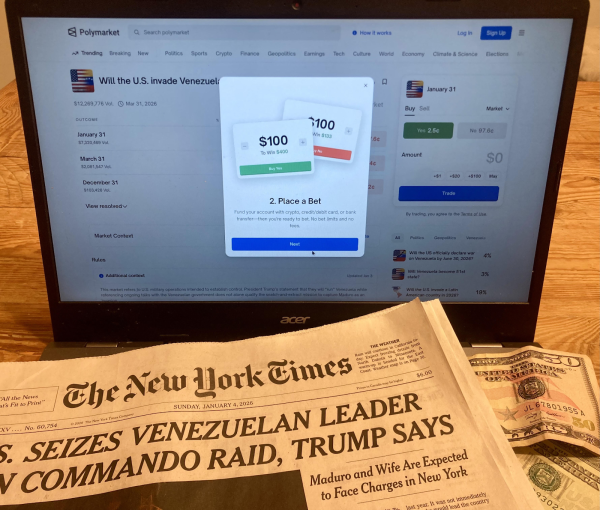
On Polymarket, users routinely place bets on high-stakes scenarios: leadership changes, ceasefires, military invasion, regime collapse. In the days leading up to the recent capture and arrest of Venezuelan President Nicolás Maduro, a user on Polymarket made $33,000 worth of bets on the market titled “Maduro out by January 31, 2026?” After U.S. forces seized Maduro and his wife, the user netted over $436,000. The timing raised questions. Was this just unusually prescient analysis, or did it suggest access to privileged information?
“Polymarket itself does very little to identify its users,” says White. She elaborates that this anonymity means, “It can be challenging to determine, is there insider trading happening here, or was it just someone who got very lucky? Who, for some reason, had never bet on that platform before then, but just decided to go for it?”
Kalshi, by contrast, operates a CFTC-regulated exchange. It is required to implement Know Your Customer verification procedures — which means Kalshi is broadly aware of who operates in their markets — and monitor for market manipulation. Polymarket has no comparable obligation, which is sometimes viewed as a selling point.
The lack of verification is a potential legal issue. Differing state laws about gambling age and the legality of gambling mean there’s nothing to stop an adolescent in possession of a VPN, crypto coins, and a dream from making some bets. Some states, including Nevada, Arizona, and New Jersey, have taken issue with this lack of restriction. Most recently, at the start of 2026, Tennessee sent cease-and-desist letters to Kalshi, Polymarket, and Crypto.com, accusing the platforms of running unlicensed sports wagering operations disguised as events contracts.
In traditional financial markets, insider trading is a federal crime. In some prediction markets, especially unregulated ones, insider trading is treated as a feature. If the primary goal is an accurate forecast, privileged information can sharpen the signal — a predictive benefit, but also an ethical cost.
While such trades might boost the accuracy of a market, they diminish its integrity. When financial gain is tied to the outcome of future events, especially political or social ones, self-interest can override responsibility. A person positioned to profit from a particular outcome may also be positioned to influence it. In those cases, the issue is about sacrificing ethics and outcomes for personal profit.
As White notes, the way we approach these risks depends on what we believe prediction markets are for. “Is it meant for people to be able to make money in sort of a fair gambling sense? Is it actually to get the most accurate possible prediction, no matter the way that you go about it? Is it to truly capture public sentiment?” These questions will become increasingly important to reckon with as prediction markets expand in scale and cultural influence.
Our world already revolves around profit. There are markets where you can buy vintage coats, markets where you can buy and sell stocks, and markets where you can trade dollars for euros. But prediction markets push this further, making uncertainty an asset. The benefits are indisputable: they harness collective intelligence and provide clear incentives for accuracy. The markets are widely more accurate and representative than current polling models, and they constantly adjust to new information. Their ability to provide actionable data can be used to make wiser decisions and allow individuals to act early on warning signals.
But what ethical complexities are introduced by a market in which you can profit from how many acres of land burn in a fire or when a country will face military invasion? How will these markets evolve and, ultimately, what are the implications of a world where every event can become profit waiting to happen? Time will tell. Wanna bet?