


On Oct. 1, the United States government began a full shutdown, which spanned until Nov. 12. During the shutdown, the Supplemental Nutrition Assistance Program — most often referred to as SNAP — was put on hold, halting the financial support that hundreds of thousands of Oregonian families rely on for access to food. On Oct. 10, the U.S. Department of Agriculture notified states of the pause on benefits.
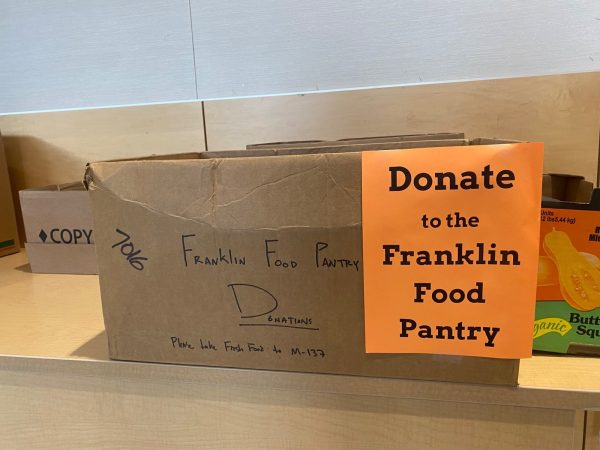
This funding pause sparked the creation of numerous initiatives to support families in need, and at Franklin, one of those resources is the Franklin Food Pantry. The new pantry provides access to a wide range of necessities, packaged and organized by volunteers. Based on need, as determined through a form that families or students can fill out, volunteers review requests and package boxes on a weekly basis, contacting families personally to inform them of when to pick up their boxes.
As outlined on the Multnomah County website, over 750,000 people in Oregon rely on SNAP, with 143,000 participants in Multnomah County. Additionally, the Oregon Capital Chronicle reports that the average individual recipient receives around $190 in benefits to use on necessities for the month. Yessica Becerra, the Step Up site manager at Franklin — a support program for high school students — began conceptualizing this project when, in early October, students voiced their concerns about accessing resources for themselves and their families. Step Up took action to create and deliver food boxes to families.
Students and staff held a community meeting soon after to discuss their desire to support local immigrant, migrant, and refugee families and how to achieve this goal. Jane Elliot, the climate and culture specialist at Franklin, summarizes that at the planning session, staff facilitators aimed to “identify one action or ‘quick win’ [they] could collaborate on to serve our students and families. The outcome … was a decision to support Step Up in their efforts to feed our community.”
A recent Supreme Court decision permitted Immigration and Customs Enforcement (ICE) to identify individuals during immigration actions based on their use of the Spanish language and their perceived race, among other facets of identity typically regarded as racial profiling. These national decisions have caused concern in many Franklin communities regarding the security of essential resources. As some families may fear leaving home for work or even groceries, staff aimed to provide resources families could access safely. Bryan Dykman, an English and AVID teacher at Franklin and an organizer of the pantry, believes that since, “ICE is racially profiling members of our community, including citizens, [the food pantry] is [a] way of showing solidarity and support for our community.”
Becerra explains that the pantry is “a space designed to support students and families by giving them access to free, culturally relevant, everyday essentials — food, snacks, hygiene products, school supplies and more.” She, alongside other staff members, coordinates the organization and supply of the pantry.
Becerra emphasizes the negative impact on one’s education that can stem from a lack of resources, saying, “Basic needs shouldn’t be a barrier to education. Right now, many families are facing high living costs, food insecurity, and financial stress.” The creation of the Franklin Food Pantry is meant to alleviate this: “The pantry supports Franklin students and their families, especially those who may not qualify for other resources or who need immediate support without stigma or paperwork,” explains Becerra.
Volunteers are required in order to maintain the pantry as an asset. Dykman highlights that the Franklin Food Pantry is “run by volunteers and with all volunteer donations.” Elliot affirms this, directly expressing to readers, “If anyone is thinking of donating, thank you, and know it is needed.”
The pantry accepts both monetary donations and direct resources. Such items include both perishable and nonperishable foods, hygiene products, menstrual products, gift cards, household items, and more. The full list of donation suggestions can be found here. According to Elliot, in the two weeks since its creation, 21 families have received food assistance, and over 30 families have volunteered to help. However, Elliot states that the pantry is still a work in progress, and not an easy task, explaining, “We are still building the system.” She elaborates, “This is a new and growing effort, and it will take all of us to make it sustainable.”
Throughout the pantry’s initiation, students in the Associated Student Body have helped package boxes, teachers and advocates have driven food to student homes, staff have organized food donations and promoted their use, and over $400 in monetary donations have been collected. “With the help of teachers and volunteers, we have been able to bring boxes of food to families who are afraid of leaving their homes, and [put] some food on the table,” explains Becerra. She continues, “The Franklin Food Pantry is not just shelves of food — it’s a project created with and for students, shaped by their voices. Our goal is to make sure every student feels supported, seen, and able to focus on learning, not on surviving.” For families in need of assistance, the form is accessible under the Families and Community tab of the Franklin High School website.