


You might have heard of the popular TV show “Alone,” where 10 survival experts are dropped into hostile environments such as frigid Labrador, Canada or the Arctic Circle, and the contestants must survive 100 days with only 10 items selected from a pre-approved list of 50. For most viewers, the show has an appealing shock factor — seeing contestants struggle for their next meals in bear territory makes a permanent roof and electric heating feel like even more of a luxury. However, for some, the emotional journey that “Alone” contestants undertake is inspiring, and begs the question, “Could I survive, if I were in their place?”
The increasing prevalence of technology in society has greatly diminished humanity’s connection to nature. However, the internet also opened up new opportunities to learn outdoor skills in a groundbreakingly accessible format, for those interested in seeking them out. “There has been, in the past, a lot of gatekeeping about these traditional skills, but I think a lot of those walls are breaking down,” describes ProudStar, a program director at Trackers Earth — a Pacific Northwestern organization that offers camps and classes in outdoor skills to people as young as three. ProudStar creates curriculum for Trackers teachers about “everything from how to catch a fish to how to run a Dungeons & Dragons 5e session for kids.” ProudStar grew up using wilderness skills in its daily life, and enjoys sharing them with others.
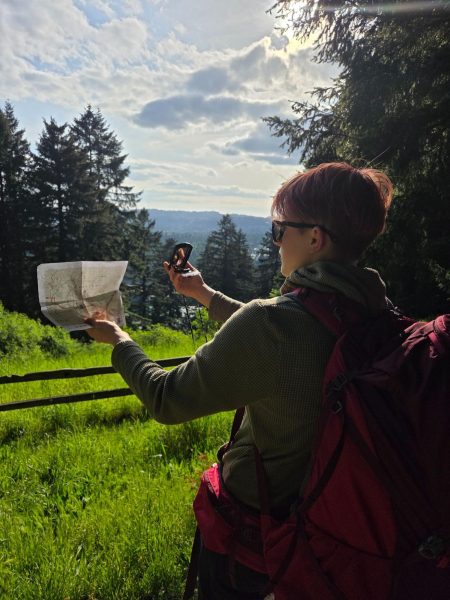
What exactly constitutes an “essential” outdoor skill varies depending on who you ask. “My favorite skill is definitely nav[igation] — I love translating my surroundings onto a piece of paper and being competent in my situational awareness,” says Liam Kean, a senior at La Salle Catholic College Preparatory. Kean is a Team Leader with Multnomah County Sheriff’s Office Search and Rescue (MCSOSAR) — a volunteer Search and Rescue program that trains teenagers in leadership and survival — and also enjoys skiing, surfing, and hiking. Navigation encompasses a wide variety of individual skills, including how to use a compass to shoot bearings — finding the angle between magnetic north and a certain structure or direction of travel — and how to find coordinates, elevation, and distances on maps. Not only is it interesting and rewarding, but like many outdoor skills, knowing how to find coordinates or triangulate your location can save your life.
Beyond life or death situations, the ability to locate your place on a map is great practice for spatial thinking, the ability to interpret and reason about the relationships of objects in space. In his 2011 book “Maphead: Charting the Wide, Weird World of Geography Wonks,” host of popular quiz show “Jeopardy!,” Ken Jennings, discusses his childhood fascination with maps, and how honing his spatial abilities benefited him later in life. “Good spatial skills are easy enough to measure,” Jennings writes. “People with these abilities are far more likely than their peers to wind up in math- or science-heavy careers, even when general intelligence is controlled for.” He also explains how this spatial thinking ability led to him developing a memory that categorized information by location, which led, in part, to his 74-game streak as a contestant on “Jeopardy!” in 2004. Understanding maps may not automatically make you a world-class trivia player, but learning to think geographically and spatially has proven to have its benefits, both indoors and outdoors.
Another outdoor skill that has overarching benefits is what ProudStar calls “food sovereignty,” which means “understanding the things that humans can and do eat around them that traditionally have been free and growing wild.” Understanding food sovereignty can be freeing because it lessens young peoples’ reliance on commercial agriculture and fast food. This is just one example of how wilderness skills can be empowering — the ability to feed oneself is a basic necessity, and especially as a minor, knowing you can grow and find things to eat outside brings a sense of control and liberation.
Wilderness survival means so much more than just the ability to start a fire or identify edible plants. To Calvin Yalon, a La Salle junior and MCSOSAR Assistant Team Leader, the most important part of his wilderness survival training is the ability to know his limits. “From my days of hiking for over 12 straight hours to trying to sleep out in inches of rain without a tent, I’ve really learned my limits … I think that it’s helped me understand [the] other areas of my life where I’m pushing myself enough or too far.” Knowing where one’s limits are, both physical and mental, can give people more confidence in their abilities, which makes it easier to do things they enjoy without fear.
Wilderness experiences have proven psychological benefits. Clinical psychologist Will Henson, who works in consulting with school districts, has studied how many social-emotional regulation skills taught in therapy can also be learned through wilderness experiences. “No matter who you are [or] wherever you are in the world,” Henson explains, “your biology and your senses and your being spent 100,000 years evolving in the wilderness. There’s a lot of your evolutionary biology as a human … that is designed to see patterns in the wilderness.” This explains why so many people feel drawn to the outdoors. If social-emotional cognition was developed in the wilderness, it only makes sense that connection with nature can help people build on these skills.
If you have an interest in learning wilderness survival, it is beneficial to start young. “It’s easier to teach little kids, to get this idea into their head that they can do hard things,” explains ProudStar. Though teens might not have quite as malleable of minds, knowledge of wilderness skills can still make a large change in their lives, especially when it comes to independence and ability to work as a team. “[Wilderness training] shows how quickly you can adapt to new situations, how quickly you can learn to be part of a team,” ProudStar describes. When you are put into stressful situations with a group, bonds form very quickly, making survival an excellent way to learn how to collaborate.
There is some inherent danger involved when spending time in the wild. Outdoor situations that rapidly become too challenging often have a tendency to become dangerous, and you do not want to be a subject of one of the approximately 1,000 search and rescue missions that occur in Oregon annually. “My biggest piece of advice would be, don’t take a risk that you’re not capable of handling,” says Kean. However, between fast-changing weather conditions and potentially unknown physical limitations, this can be easier said than done.
Additionally, though some survival skills can be learned online, much of the equipment and training necessary to gain real survival experience must be bought, and is not cheap. For example, a weeklong Trackers day camp for teens can cost upwards of $600, which is not a price many families are able to pay.
One way to combat both the danger and cost of wilderness activities is to go in a group. “Find someone who is competent in the woods, and then just tag along with them,” recommends Kean. Whether you go on your own or in a group, starting with smaller and easier hikes or trips and working up to more challenging excursions is absolutely a good strategy. For learning more specific skills, ProudStar recommends contacting people who live outside of urban areas. “Hunting, gathering, wild foods, firewood, camping — these are things that a lot of people do around the world, constantly, because it’s a necessity,” it explains. In addition, there are free events all around Portland where outdoorsy people can get together and share their survival tips. These events include Rewild Portland’s Resilient Skills Series, which offers free or low-cost classes to people of all ages, and Trackers Skills Nights, where guides introduce community members to a variety of skills at no cost.
Whether you are interested in learning wilderness survival for the personal and emotional benefits or you simply want to be a more competent hiker, it is absolutely worthwhile to take the time to learn. Not only do the abilities to build a fire, read a map, and forage for food make outdoor activities safer and easier, but they can be empowering in other areas of life. Especially for young people, spending time in the wilderness can lead to the development of independence, self-actualization, and increased ability to cope with difficult situations, not to mention the numerous therapeutic benefits it offers. Whether you decide to go to a summer camp, teach yourself through internet tutorials, or take a hike with a more experienced friend, wilderness skills are absolutely worth taking the time to learn.