

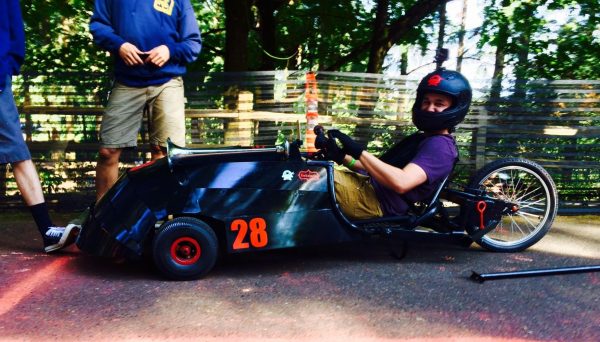
Every summer, the slopes of Mount Tabor Park transform into a racetrack as thousands of spectators gather for the PDX Adult Soapbox Derby, one of Portland’s most beloved traditions. Now in its 27th year, the derby has grown from a small, scrappy race into the largest single-day, volunteer-run event in Portland, according to event volunteer and organizer Alex Streeter. The event traces its roots back to 1997, inspired by a similar race in San Francisco’s Mission District. Since then, it has evolved into a full-scale production that draws crowds of up to 20,000 people each year.
A soapbox derby is a gravity-powered car race where participants build small, engine-free vehicles and race them downhill. Since the cars are propelled only by gravity, drivers control their descent by strategically braking and steering.
Planning for the PDX Derby happens throughout the year, with a volunteer board handling everything from permits and vendor coordination to social media and outreach. “It’s a year-round effort,” says Streeter. In mid-May, however, preparation really heats up. “Starting in May, it’s all hands on deck,” Streeter adds. “There’s a lot that goes into preparing for a crowd that size.”
The PDX Adult Soapbox Derby’s scale requires significant coordination beyond arranging the race itself. Organizers work with city officials, park staff, and emergency services to manage road closures, crowd flow, and safety along the course. Keeping the event free and accessible has always been a priority for the PDX Derby, which is why it relies heavily on volunteer labor and community partnerships.
At the heart of the derby are the racers themselves, who spend months — and sometimes years — perfecting their gravity-powered cars. Veteran teams, some of whom have been competing for decades, tinker year-round to improve their vehicles’ speed and steering. Newcomers, on the other hand, often begin their builds in the weeks leading up to the derby. According to Streeter, it’s not uncommon for teams to arrive on race day with paint still drying on their cars.
For longtime attendees like Elisabeth Dyer, the creativity is what keeps them coming back. Dyer, who has attended the derby for around a decade, says the best part of the derby has been getting to see the carts that people make. “There have been lots of cool ones in past years, but some that come to mind are the Volkswagen bus and a tiny [U.S. Postal Service] truck!” says Dyer.
Alongside the great creativity on display, the derby has a few rules. Cars must meet specific requirements for length, width, height, and weight, but within those limits, participants are free to design whatever they can imagine. Vehicles built for the derby are typically divided into two categories: speed cars and art cars. Speed cars are built for efficiency, usually low-slung, aerodynamic, and designed to shave seconds off of their downhill runs. Art cars, however, are the event’s main attraction; past entries include the appearance of fantastical creatures and elaborate themed builds that fall somewhere between racecar and performance art.
A number of Portland racers travel to Maryhill Loops Road, a steep, winding course in the Columbia River Gorge known for its demanding turns and extended descent. There, soapbox cars can exceed 40 miles per hour, offering a more speed-focused counterpart to Portland’s race.
These diverse events reflect the range of approaches within soapbox racing, from art-focused builds to competitive speed designs, and illustrate why the sport continues to draw both participants and spectators year after year. The cars’ designs reflect the creative spirit of Portland, an imaginative mix of weird and memorable. You can watch the PDX Adult Soapbox Derby for free at Mt. Tabor Park on Saturday, Aug. 15 from 10a.m. to 4p.m.!