

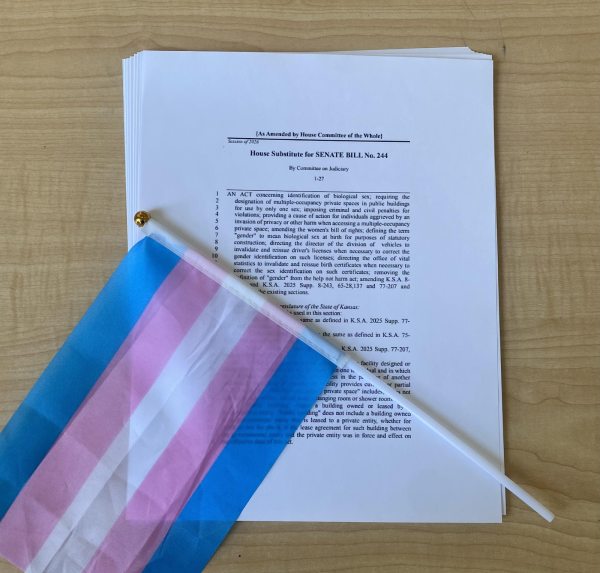
On Jan. 28, 2026, Kansas House Substitute for Senate Bill (SB) 244 passed after a nearly six-hour floor debate. The bill disallows self-selection of gender markers on official government documents, and invalidates all driver’s licenses and birth certificates with gender markers that do not match an individual’s assigned sex at birth. Additionally, it restricts the use of bathrooms and locker rooms in public spaces to those of one’s assigned sex at birth.
According to the Human Rights Campaign, SB 244 creates the ability to file “bounty-style lawsuits” against others, allowing those who believe they’ve shared a bathroom with a transgender person to file lawsuits of at least $1,000 in damages. No grace period was provided for licenses impacted by the bill, whose holders were instructed to surrender their license to the DMV in order to get new licensure reflecting their assigned sex at birth.
On Feb. 18, 2026, Kansas Governor Laura Kelly’s veto of the bill was overridden by a House vote. In her statement on Feb. 13, Kelly cited her concerns of how the “poorly drafted bill” had negative implications for all Kansans, not just transgender people. The language of the bill failed to account for a number of circumstances in which a person of a different gender would enter such “single-sex spaces” as described in SB 244, such as a young girl going to the bathroom with her father and a brother visiting his sister’s college dorm, Kelly exemplified.
SB 244 built off of a previous Kansas bill, Senate Bill 180, a self-described “women’s bill of rights” that articulated a series of legal definitions that defined all gender-related terms to sex assigned at birth, effectively excluding transgender people.
According to Williams Institute at the UCLA School of Law, transgender people are over four times more likely to experience violent crime in comparison to cisgender people. They also found that “bathroom bills” like SB 244 increase the incidences of harassment against transgender people, who are excluded and misgendered by bills like SB 180 and SB 244.
Both SB 180 and SB 244 have been criticized by civil rights groups for their conflation of sex assigned at birth and gender. “[Senate Bill 244] assumes that those categories are static,” explains Casey Goldstein, a transgender doctoral student of political science and graduate employee at the University of Oregon. “It also doesn’t encompass intersex people, who may be inherently outside of the gender binary.”
SB 244’s introduction received widespread backlash both from transgender rights activists and from dissenting Kansas representatives. “Procedurally, it is the absolute worst bill I have ever heard in the Kansas Legislature,” commented Rep. Dan Osman, according to the Kansas Reflector. The “gut and go” tactic used to pass the bill has drawn criticism from many significant activist groups such as the Human Rights Campaign and the American Civil Liberties Union (ACLU). “[SB 244] was pushed through by legislators who subverted regular democratic rules so that the bill received no public testimony,” says Matthew Neumann, a transgender man and founder and executive director of LGBTQ Foundation of Kansas, a nonprofit focused on connecting queer people to resources, community, and mutual aid.
“Gut and go” is a legislative tactic in which either the House or the Senate passes an inoffensive bill off to the other chamber, who then strips the bill of its original purpose and refills it with unrelated laws — “gutting” it — then sends it back to the original chamber to be approved with a yay or nay vote — the “go.” This maneuver avoids the typical period of public testimony and more extensive debate that would typically accompany the passage of more controversial bills.
In the case of SB 244, the original Senate bill set rules and regulations for bail bond companies in Kansas; it did not mention bathrooms, gender markers, or sex. But when it emerged from the House, it was completely different.
According to Trans Legislation Tracker, 1,022 anti-transgender bills were introduced in the U.S. in 2025, with 126 of them being passed into the legislature. In 2026 so far, 755 anti-transgender bills are currently being considered. “I think the trans community has been used as a scapegoat and distraction from the fact that lawmakers are taking no action on the issues people truly care about, like the economy and the war in Iran,” comments Neumann.
In Kansas, the transgender community is in “chaos,” according to Neumann. “This bill has caused fear and confusion among the community,” he says. “It has been rolled out poorly. … They stripped identification from some of our community members, [but] not all.” Those with affected licenses were supposed to be notified by the DMV, but it is unclear whether this is occurring.
Across the country in Oregon, most bills pertaining to transgender people look to protect rather than restrict. As of 2023, Oregon is a transgender refuge state, meaning that it offers specific protections to the patients and providers of both gender-affirming and reproductive healthcare. This protection was strengthened by the 2026 House Bill 4088, which creates additional medical and legal privacy rights for providers and patients.
Goldstein describes how bills like SB 244 are less likely to pass in progressive states like Oregon. “Oregon legislatures have a track record for passing legislation that protects transgender rights, instead of taking them away,” says Goldstein. He adds that, while transgender Oregonians are likely safe from “bathroom bill” legislation like Kansas’, he is still worried about “federal policies that [could] override state policies.”
Currently, two anonymous transgender men represented by the ACLU and Ballard-Spahr law firm are suing Kansas over SB 244, alleging constitutional violations as well as safety concerns. The LGBTQ Foundation of Kansas has four relocation teams working with queer Kansans who are leaving the state out of fear, and also offers safety training and mutual aid for those staying. “I was raised Kansas strong, and I don’t budge easily,” says Neumann. “My advice is to find your joys. Even small. They can’t take away our joy.”