


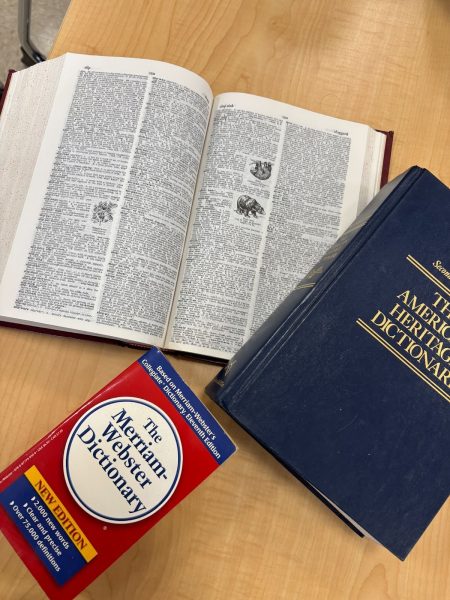
Six-Seven. Rage Bait. Slop. Parasocial. These are the 2025 words of the year. At the end of the year, many dictionaries — such as the Oxford dictionary — choose a word that reflects the year’s cultural and societal trends. Despite its relatively short history, many critically recognized dictionaries have participated, contributing to the influential trend. The word of the year is a popular phenomenon because “As humans, we are natural categorizers,” says Kevin Holmes, associate professor of Psychology and current department chair at Reed College.
Each dictionary has a different method of selecting a word. Most have editorial teams composed of lexicographers and linguists that work together to identify a shortlist of words based on popularity and cultural trends, and then use this information to decide on a final word.
Dictionary.com notes that, “To select the 2025 Word of the Year, our lexicographers analyzed a large amount of data … to identify words that made an impact on our conversations, online and in the real world.” This eventual decision is also guided by analysis of search trends on their website — for example, since June, searches for “six-seven” have increased sixfold.
The Oxford languages website has a similar process, noting that the word they choose reflects the mood of the year has “lasting potential as a word of cultural significance.” They also note that they were “among the first institutions to have a Word of the Year.” Oxford has an editorial board that identifies a shortlist of words, but often allows public vote to decide the final word.
The wildly popular phrase “six-seven” is virtually undefinable, yet has become an ubiquitous favorite of many individuals, particularly elementary and middle school children, for much of the fall. Dictionary.com notes that despite its undefinability and connections to brainrot culture — the term describing the increasing consumption of low-quality, short-for content on social media — “it remains meaningful to the people who use it because of the connection it fosters.” Meanwhile, the Oxford word of the year was “rage bait,” another term popularized by social media referring to content designed to provoke anger with the goal of invoking a response. In 2025, its usage tripled. The Cambridge Dictionary word of the year was “parasocial,” a term for the one–sided relationships people form with celebrities, artificial intelligence (AI), or other famous figures.
Choosing a word of the year has become an enormously popular trend amongst many, both reflecting and shaping the cultural trends of the year. Holmes notes that, in choosing a word of the year, dictionaries’ editorial boards often choose words “intentionally to shape culture” or to send a message. For example, he believes that this year’s words may have been chosen to alert the public about the dangers of internet culture. He believes that “Even though the words [chosen in 2025] are different, they’re all hitting on a common theme,” namely how we can be manipulated online.
Oxford languages notes that “language matters” and the word of the year is a “concept that continues to be close to our hearts.” Holmes agrees with this, noting that through language we balance the tradeoff between simplicity and informativeness. Language cannot explain everything — we use words to categorize experiences, and thus, they sit at the balance point between clarity and detail. Language evolves based on communicative need, and “Certain words really stand out [and] serve as summary statistics for the events of our lives.” Holmes says, another reason the word of the year is popular.
Many words of the year do remain powerful summary statistics even years later, representing trends we remember or continue to see. For example, in 2020, all of the words of the year were related in some way to the COVID-19 pandemic, and in 2021 many of them were related to the COVID vaccine. Since 2023, most of the words chosen have been related in some way to the rise of AI and short form content. These words, ranging from “brainrot” to “polarization,” reflect a fundamental part of internet culture. This is somewhat due to the fact that “young people are [often] drivers of culture,” notes Holmes, and are often overrepresented both online and during the process of selecting the word of the year.
However, not all words of the year remain relevant or even remembered; often they mark trends that soon die out completely. For example, Oxford’s 2022 word of the year was “goblin mode” and Cambridge’s was “homer.” While these words are largely absent from our cultural lexicon today, just three years ago they were enormously popular. Homer, an informal term for a home run in baseball, was a Wordle answer in May 2022. According to Cambridge Dictionary, it was the highest spiking word in all of 2022, searched over 75,000 times that week.
These words highlight the duality of internet culture particularly well: massive trends tend to either persist for long amounts of time, often evolving to stay relevant, or they vanish completely.
The word of the year — alongside other summary statistics such as Spotify Wrapped — are entertaining trends for many. However, “We should be cautious not to read too much into these summary statistics,” Holmes notes, “because they don’t capture nuance.” While these summaries can be meaningful, they represent only one aspect of a much larger and more complex cultural landscape, and risk oversimplifying trends that are far more nuanced. Franklin students report that their words of 2025 were “thoughtful” (Lila, freshman), “spectacular” (Chelsea, sophomore), and “chuzz” (Ellery, senior).
Whether they continue to be synonymous with culture or slowly fade into oblivion, the word of the year reflects an important aspect of human culture: our tendency to categorize our existence. “We like to put labels on things,” says Holmes. “The word of the year is part of a trend to come up with words that capture something about the zeitgeist of our times.”