

elle Gallery, founded by Laura LeSeueur, hosted the First Gen Fashion Show in downtown Portland on Nov. 22, showcasing the talent and hard work of up-and-coming designers. Attendees of the event ranged from independent bridalwear designers to Nike technical designers to a winner of the Ms. Black Oregon 2026 pageant, all gathered in support of friends and rising community members within the Portland fashion industry. Several designers’ collections — including lines designed by Palopsee, Praise Yakubu, Joshua Stewart (Prismdrifter), Sam Serrif (Maison Serrif), Ben Matarangas (Lokiez), and Jolly Thoughtz — were worn by local and aspiring models.
elle Gallery’s doors opened at 6 p.m.. Guests streamed in, dressed in furs, leathers, and a variety of ornate silver jewelry reflecting a standard of glamorous dress for the night. New and gently used shoe donations were accepted at the entrance, which were then donated to those in need. Tickets were sold on Eventbrite and advertised through the Instagram account @firstgenfashionshow, with prices at $26 for a general admission ticket and $46 for a guaranteed seating ticket. The catwalk extended through both a main and an additional room, allowing all unseated guests a close-up look at the featured pieces.
Charles Shambry, Portland radio show host of “Interviews with Charles Shambry,” facilitated the event as Master of Ceremonies. “Interviews with Charles Shambry” is a nonprofit organization which aims to amplify the voices of minority community members, specifically entrepreneurial women making a positive impact. The show is aired on Xfinity cable channels and broadcasts through KBOO community radio stations, with over 500,000 listeners in the Portland metro area. After a brief introduction by Shambry, the lights cut and electronic dance music queued as the models took their positions.
The show began with the first designer, Palopsee. Model Sami McNeil showcased a matching sweatshirt and sweatpants upcycled from a quilted tapestry, paired with neon eyeshadow and face gems. Palopsee was invited to participate in the show at the last minute, and managed to create his piece and contact McNeil, who flew in from Pittsburgh to walk the show, in only a matter of weeks. Through recycling tapestries into modern lounge wear, he intends to inspire sustainability beyond the Portland region. “It’s a real-life interpretation of fantasy, and having people from all around come together to witness this opportunity is just great,” said McNeil. Palopsee has also appeared in other local fashion events, including the Fifty Shades of Textiles event which similarly centered upcycled clothing.
Following Palopsee, Praise Yakubu’s collection featured mended patchwork denim jackets and recycled military bags repurposed into industrial trench coats fastened with silver firefighter clasps and popped collars, which were contrasted with black leather miniskirts and knee-high heeled boots. Yakubu was introduced to the world of fashion through his mother, who owned a tailor shop in Nigeria. He began sewing in 2019, developing his career through social media platforms such as TikTok and Instagram. In conversation with VoyageLA, a Los Angeles magazine that covers arts and culture, he explained that growing up in Nigeria and beginning his fashion career with solely hand-sewn pieces differentiated him from other artists. Through the platform Thumbtack, which connects users with local service professionals, Yakubu offers an alterations business and hemming, sewing, and styling lessons.
At this point in the show, sound system technical difficulties halted the runway. Despite the disruption, Geneve — a model for Joshua Stewart’s brand, Prismdrifter — struck a pose in an elaborate zebra fur set, glancing over her shoulder towards the audience as the room regained sound. An independent and self-proclaimed “avant-garde” clothing designer, Stewart’s collection was based on “severe weather and tornadoes.” He emphasized that it was also an allegory for all the difficulties he’s overcome in life: “We have all had our storms we’ve weathered through.” He presented long, elaborate dresses; chaotic fur jackets with jagged edges and loose strips; and bold makeup looks, such as silver-studded lips. He encapsulated a poetic representation of harsh emotions and how storms may be equally comforting as they are dangerous. To portray this, he wanted to explore the impacts of global warming and put forth sustainable practices through repurposing manufactured products such as shoelaces and unused, mass-produced materials.
After the tornado of Prismdrifter’s designs whirled through, Maison Serrif’s first model began her walk, sporting a blue leather jacket and matching patchwork leather pants with Serrif’s signature skull logo on the back. Serrif’s collection contained teal, gray, lime green, forest green, and dark brown leather jackets, and androgynous layered outfits. Kaylyn Franklin, who walked in Portland Fashion Week and has been professionally modeling since April 2025, explained how fascinating it was for her to watch the artist “express themselves through means of clothing, and get to embody those emotions for the night.” Serrif offers a limited repurposed leather line of rock climbing chalk bags, wallets, and keychains.
Following Serrif, Ben Matarangas, a recent graduate of the University of Oregon Industrial and Product Design program, presented his Lokiez line. He stated that in designing his collection, his intention was to resonate and identify with anyone, “no matter the background or aesthetic style” of the clothes. The outfits drew on 1970s-esque golf uniforms, with antique golf clubs as props, business casual pleated pants paired with alarmingly tall high heels, and even higher-reaching thigh-high stockings. Lokiez is a line based on stylish athleisure, including a snowboarding jacket and pants inspired by the 1990s streetwear era in skateboarding culture.
Jolly Thoughtz, the last designer of the night, noted her excitement and nerves shortly before the show. She explained that she started with “small crochet projects,” before appearing as a featured independent designer. Her looks included vintage houndstooth and tartan-patterned skirts and dresses, with unique draping. Dresses were uniform and straight-cut, with asymmetrical capes attached with striking, large black and white buttons. Buttons were a recurring statement piece throughout the line. One model memorably walked dressed in a mini dress and a necklace with a black button the size of an orange.
Many guests, models, designers, photographers, and spectators in attendance offered their praise for the show in Shambry’s red carpet interviews held afterwards. Ms. Black Oregon 2026, Carmen Cowan, interviewed guests for a feature on Shambry’s Instagram, inquiring about their personal fashion opinions and advice. Imani Jackson, a guest who works as a technical designer at Nike, said that the community in Portland supports local events. “The amount of people who show up to events of all ages, of all parts of life, [is] really admirable,” she explained.
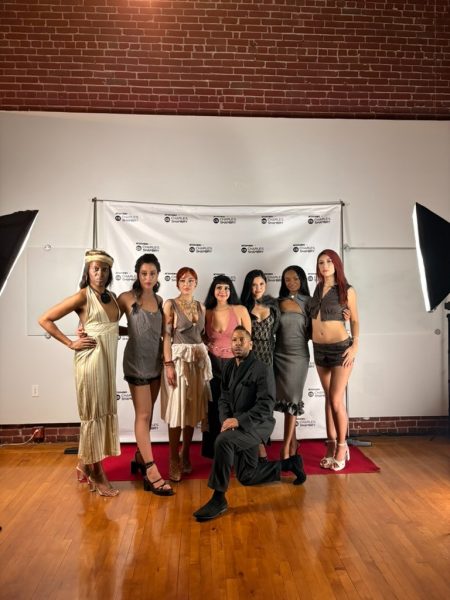
The show closed, having displayed a theme of sustainability and inclusivity, with a final walk-through of all the models and designers. Throughout the night, values Portland prides itself on, uniqueness and creativity, were manifest in the designs.. By centering emerging designers and giving them a platform to share their work, elle Gallery fosters a space where identity, craft, and community can converge. Portland’s fashion scene is constantly evolving, and its future is continually shaped by the ingenuity and participation of the community who shows up for it.